You've definitely heard this phrase before.
Maybe it's what your parents said, maybe it's what the doctor said, or maybe it's what you started saying to yourself after a fall or injury.
"You're getting old, don't move around too much."
The starting point of this statement is protection. It stems from genuine concern—the older generation's bodies are more vulnerable, and they recover more slowly from injuries, so less movement is safer than more movement.
But this statement had a very serious consequence.
Immobility accelerates bodily degeneration.
This is the most important fact, and also the one most often overlooked:
For older bodies, the harm of inactivity far outweighs the risks of appropriate movement.
When an older person begins to reduce their activity—walking less, climbing fewer stairs, and doing less of anything that might be "dangerous"—what happens to their body?
Muscles begin to atrophy. Studies show that after the age of thirty, without consistent resistance training, people lose about three to five kilograms of muscle mass every ten years. By the age of seventy or eighty, if this loss is not addressed with appropriate exercise, basic daily functions will gradually be lost—standing becomes difficult, walking becomes unsteady, and climbing stairs becomes strenuous.
Decreased bone density. Bones need to bear weight to maintain their density. When the body is not moving, bone loss accelerates, increasing the risk of fractures.
Joint degeneration. Articular cartilage lacks a blood supply and relies on movement to circulate synovial fluid for nourishment. Inactivity causes synovial fluid to stagnate, leading to cartilage dehydration and accelerated joint degeneration—the exact opposite of the logic that "less movement protects joints."
A decline in balance and reaction speed. This is the primary reason why older adults fall—not because their bones are too brittle, but because their nervous system has lost the ability to dynamically perceive and react instantly, as this ability has not been trained and used for a long time.
"Don't move around" is precisely what is accelerating the very problems it is trying to prevent.
"Disorderly movement" and "intelligent seismic activity" are two different things.
There is an important distinction here.
The criticism of "don't move around" targets actions that are unprepared, unguided, or lack understanding of the body's current state. This criticism has its merits.
It is indeed risky for a 70-year-old to suddenly run a marathon. It is also possible for someone with osteoporosis to get injured when engaging in high-impact jumping exercises.
But this is not a reason for "not moving," but a reason for "intelligent earthquakes."
The concept of "wise movement" means finding a suitable way of moving based on the body's current state, allowing the body to be continuously used, nourished, and strengthened in that way.
For older people, this "intelligent seismic activity" is more important and deserves to be taken seriously than for any other age group.
What kind of movements do older people need?
Research tells us that the movements most beneficial to the body in older adults share several common characteristics:
Multidirectional, nonlinear
Falls among the elderly most often occur due to unexpected movements—missing a step, turning suddenly, or tripping over something. These situations require the body to react quickly in a non-linear direction.
However, most exercise for older adults—walking, stretching on a fixed machine, chair exercises—is linear and predictable. These exercises can help with cardiovascular and muscle strength, but they cannot train the body to coordinate responses in unpredictable three-dimensional situations.
There is a requirement for dynamic equilibrium.
Static balance training (standing on one leg) has its value, but true fall prevention requires dynamic balance training—continuously adjusting the center of gravity while moving and finding stability in unstable conditions.
Integrate the whole body, rather than isolating parts.
Falls and injuries in older adults are often not due to a lack of strength in a particular muscle, but rather a decline in overall coordination. Isolated, localized training—focusing solely on leg strength or grip strength—cannot solve the coordination problem.
Enabling the nervous system to learn continuously
This is the most important one. Neuroplasticity persists into old age—the brain and nervous system can still form new connections, learn new coordination patterns, and improve the accuracy of proprioception even in one's seventies or eighties.
However, this kind of learning requires novel and challenging motor stimulation. Repeating the same movements does not require the nervous system to be truly engaged.
Why is Chanrou (a type of skin) particularly suitable for older bodies?
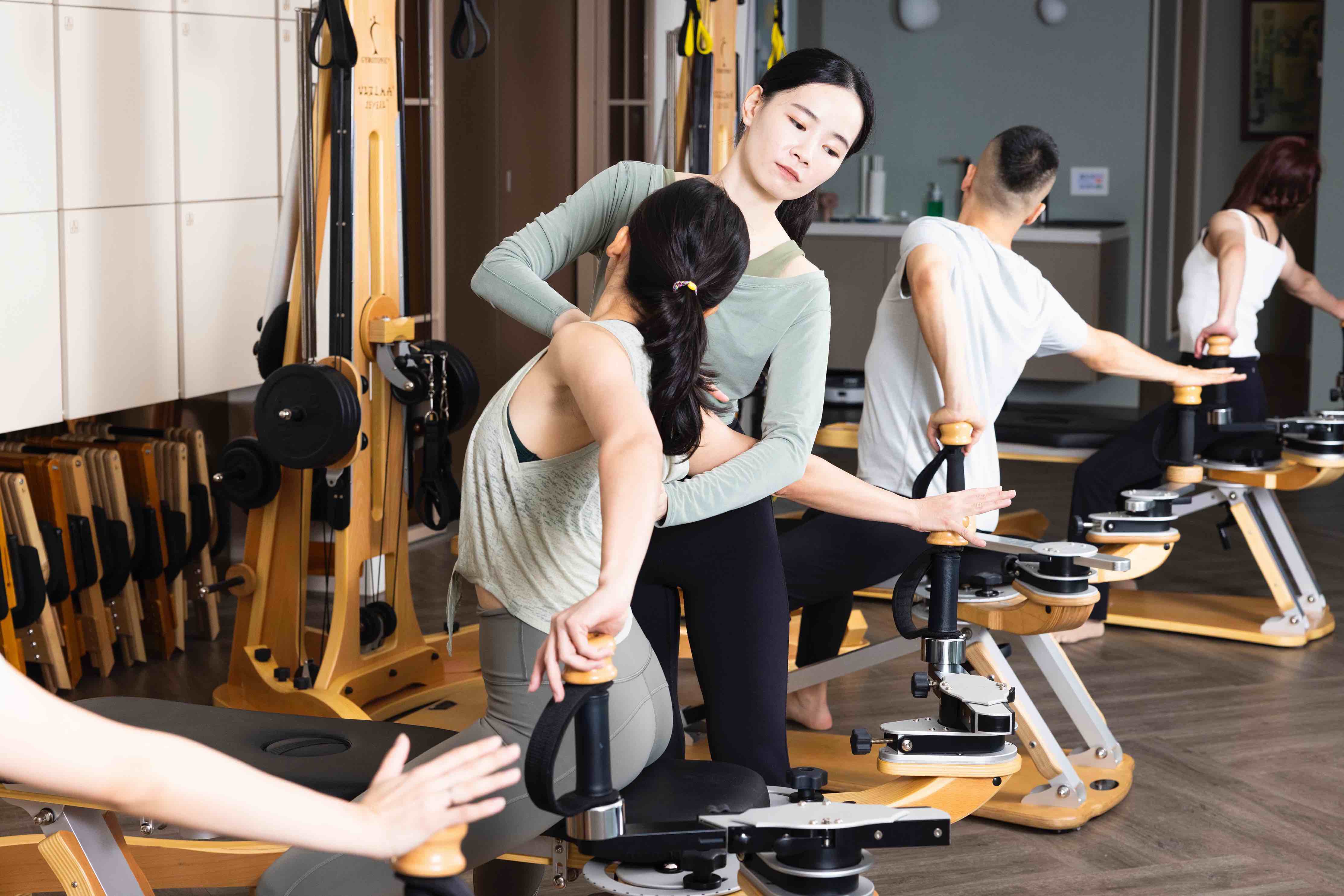
Chanrou's design logic almost perfectly matches the needs of older people.
Starting from the current body
Chanrou doesn't have a standard that everyone must reach. It starts from your current body—no matter what your starting point is, Chanrou can find a suitable way of moving from that starting point.
A person who starts practicing at seventy and a person who has been practicing for ten years at thirty can do completely different levels of practice on the same equipment.
Three-dimensional spiral movements train the coordination needed in real life.
Chanrou's multi-directional movements continuously challenge the nervous system's coordination ability in three-dimensional space—this is precisely the ability most needed to prevent falls in daily life.
Every Chanrou class is a learning opportunity for the nervous system in a non-linear, dynamic context.
Extending in opposite directions protects the joints while allowing them to move.
The gentle, opposing extensions allow the joints to move under reduced pressure—not through compression, but through fluidity. This allows older joints to be used fully without bearing unnecessary compressive loads.
Activating the deep core fundamentally improves the balance.
The deep core system of Chanrou training is the most important foundation for dynamic balance in older adults. When the pelvic floor muscles, transverse abdominis, and multifidus muscles are truly engaged, the stability of the entire body during movement is fundamentally improved—not by the support of superficial muscles, but by the internal support of the deep system.
The support of equipment allows safety and challenges to coexist.
Chanrou's Pulley Tower apparatus provides a continuous, resilient support—allowing learners to perform challenging yet safe movements with the aid of the apparatus.
This support is especially important for older learners—it allows them to explore the possibilities of physical movement with safety in mind, rather than stopping their exploration for fear of falling or getting injured.
The real risk is stopping the movement.
This is the most crucial sentence in this article.
For older bodies, the risks of stopping moving are far greater than the risks of wisely continuing to move.
Muscle loss, bone loss, joint degeneration, decline in the coordination of the nervous system, and loss of balance—all these occur at an accelerated pace in a still body.
If the advice "Don't move around too much when you're old" becomes "Move less when you're old," it will bring about the very consequences it tries to prevent.
Intelligent earthquakes, based on the body's condition, find suitable ways to ensure that the body is continuously used, nourished, and cared for throughout the second half of life—this is true protection.
As you get older, you need to move around even more.
It's just a matter of moving more intelligently, more consciously, and with a better understanding of your own body.