"The doctor said I have a herniated disc. Can I still exercise?"
This is the first question many people ask after receiving a diagnosis.
The answer is: yes—and for many, proper exercise not only won't make things worse, but it's actually key to recovery. But the key phrase is "proper exercise."
What is a herniated disc?
Between the vertebrae of the spine is a structure resembling a sandwich filling in a jelly—an outer layer of annulus fibrosus and an inner layer of nucleus pulposus. This structure is responsible for absorbing the pressure on the spine while maintaining its flexibility.
When the annulus fibrosus ruptures due to long-term pressure, poor posture, or acute injury, the inner nucleus pulposus protrudes outward and compresses nearby nerve roots—this is a herniated disc.
Symptoms may include: localized lower back pain, radiating pain along the nerve pathway (sciatica), numbness or weakness in the hands and feet, and in severe cases, even affect walking and daily life.
Intervertebral disc herniation most commonly occurs in the lumbar spine (L4-L5, L5-S1) and cervical spine, and is relatively rare in the thoracic spine.
Why isn't "staying still" the answer?
When many people receive a diagnosis of herniated disc, their first reaction is, "Then I have to lie down and rest, and I can't move."
But modern spinal medicine no longer thinks this way.
Complete rest can actually worsen the problem: the intervertebral discs rely on dynamic compression and release for nutrition, and inactivity means that the intervertebral discs continue to dehydrate; the core muscles quickly become disused when at rest, and the spine loses support; the fascia begins to adhere, and the perception of pain becomes more sensitive.
What is truly needed is the right kind of movement—allowing the spine to regain fluidity and support without increasing pressure.
Why is GYROTONIC® and GYROKINESIS®'s design particularly suitable for herniated discs?
Spinal decompression: Creating space in motion
The intervertebral discs are most vulnerable to "vertical pressure." During weight training or prolonged sitting, gravity constantly compresses the spine, causing the intervertebral discs to lose moisture and elasticity under this continuous compression.
GYROTONIC® and GYROKINESIS®'s logic is not "anti-gravity," but "extension." The constant resistance provided by the equipment (Pulley Tower) guides practitioners to perform antagonistic extension—the top of the head extends upward, the tailbone roots downward, and the spine is gently lengthened between the tensions at both ends. Combined with self-practice of the Narrowing sequence, it helps to truly liberate the spine from its compressed state.
This is not passive traction, but rather the body actively creating space for itself—the compression of the intervertebral disc is released, and the protruding part has room to breathe.
Many patients with herniated discs say the same thing when they first move on the GYROTONIC® and GYROKINESIS® device: "I never knew my back could feel so light."
Promotes circulation and accelerates repair
The gentle, rhythmic spiral motions and breathing movements can subtly alter the pressure inside and outside the intervertebral disc, promoting the flow of nutrient fluid and helping injured discs regain elasticity and moisture. Simultaneously, it increases blood circulation to surrounding muscles and fascia, accelerating tissue repair and reducing chronic inflammation.
Activating the deep core: Providing true support for the spine
A core problem with herniated discs is the lack of sufficient active support for the spine—the deep stabilizing muscle groups (multifidus, transversus abdominis, pelvic floor muscles) are not used, and the spine relies on superficial muscles to compensate, which puts more pressure on the intervertebral discs.
GYROTONIC® and GYROKINESIS®'s Seed Center training and pelvic narrowing techniques reactivate this deep system. It's not about actively "tightening your abdominal muscles," but rather about using breathing and intention to allow the deep muscle groups to naturally form support—protecting the spine from the inside, rather than relying on surface force to hold it up.
When the deep core is truly activated, the burden on the intervertebral discs is reduced, and the pain often improves as well.
Multiplanar flow: Breaking the vicious cycle of compensation
Patients with herniated discs often avoid certain movements due to pain, and the body begins to develop compensation—some muscle groups overuse while other parts remain completely still. Over time, this compensatory pattern becomes entrenched, and even if the herniated disc heals, the pain persists because the body's movement pattern has been altered.
The gentle three-dimensional spiral movements allow the spine to flow evenly in all directions of forward bending, backward bending, rotation, and lateral bending, gradually breaking the compensatory pattern and reactivating forgotten movement paths.
Recalibrating the nervous system: stopping the brain from over-exertion
Chronic pain is not just a tissue problem, but also a problem of the nervous system. Patients with herniated discs often have their nervous system in a state of high alert for a long time—the pain threshold is lowered, and actions that should not normally cause pain begin to trigger pain.
The gentle, rhythmic breathing and wave-like movements directly stimulate the vagus nerve, helping the parasympathetic nervous system take over. As the nervous system de-escalates from its chronic alert state, pain sensitivity can be reversed, and movement becomes safe again.
Which actions require caution?
Patients with herniated discs need to pay special attention to several things when practicing GYROTONIC® and GYROKINESIS®:
Avoid forcing a range of motion during the acute phase. During an acute attack, the primary goal is to reduce inflammation and nerve compression; range of motion should be conservative, with the principle of not causing radiating pain.
Flexion movements require individual assessment. Extensive forward flexion may not be suitable for certain types and locations of disc herniation—especially posterior herniation. Experienced instructors will adjust the direction and range of motion based on the location and direction of the herniation.
Stretching movements are generally safe, but still require control. In most cases of posterior lumbar disc herniation, spinal extension is usually safer than forward bending, but it should still be performed under the assessment of an instructor.
Radiation symptoms are important warning signs. If any action worsens radiating pain, increases numbness, or reduces muscle strength, stop immediately and inform your instructor.
Different practice strategies for different stages
Acute phase (1-4 weeks after onset): The goal at this stage is stability, not activity level. Exercises should focus on breathing exercises and minimal core activation, with a very small range of motion, designed to completely avoid triggering symptoms.
Subacute phase (4-12 weeks): As inflammation gradually subsides, more movements can be introduced, but caution is still advised. The focus is on building deep core control and gradually restoring spinal mobility in all directions within safe limits.
During the chronic or recovery phase, more complete GYROTONIC® and GYROKINESIS® exercises can be performed, with the goal of breaking compensatory patterns and establishing long-term spinal health habits. Many patients find at this stage that GYROTONIC® and GYROKINESIS® not only helps with intervertebral disc problems, but also improves the overall quality of their movements.
Professional practice advice
Although GYROTONIC® and GYROKINESIS® (a traditional Chinese medicine) is significantly helpful for treating herniated discs, three important principles must be followed in its application:
Medical priority—Before starting any exercise program, a diagnosis by a physician or physical therapist is necessary to confirm that the condition is in a "non-acute inflammatory phase." Any case with acute neurological symptoms should undergo medical evaluation before considering exercise intervention.
Avoid extremes—In initial practice, avoid excessive forward bends (curl) or excessive arches. Instructors will guide students to find fluidity within a "pain-free range," rather than forcing the movements into perfect form.
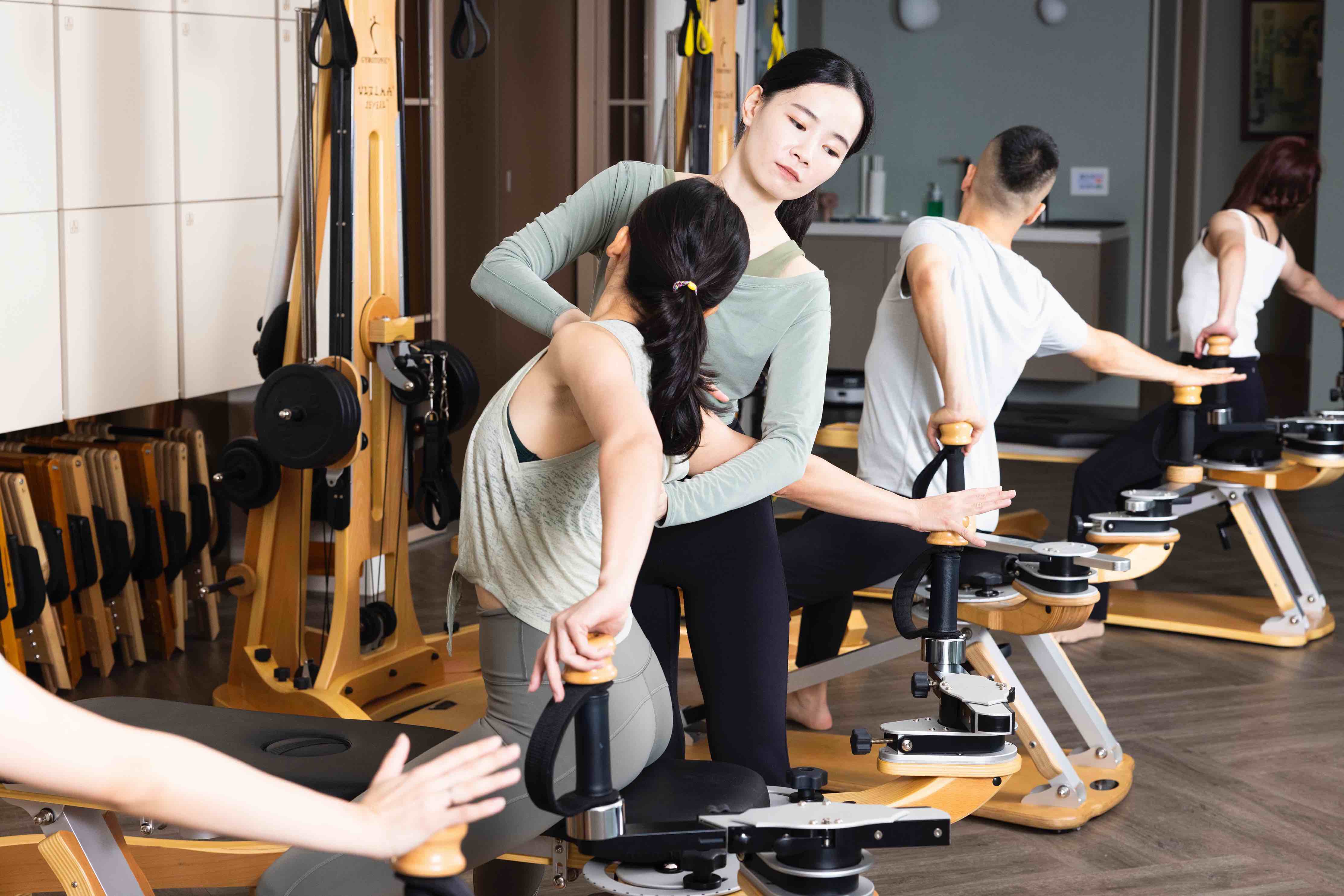
Precise guidance—We strongly recommend seeking one-on-one private lessons with a professional background. Through precise verbal instructions and hands-on guidance from an instructor, you can ensure proper power transfer, avoid compensation, and make each practice session truly effective.
GYROTONIC® and GYROKINESIS® doesn't aim to "cure" herniated discs. Instead, it uses a low-impact, spiral flow method to create a decompression environment for the injured disc, improve circulation, and rebuild the correct stability pattern, thereby reducing pain, restoring function, and improving quality of life.
A herniated disc is not the end of the journey. It's a signal—telling you that the way you use your body needs to change. And the way to change isn't to stop moving, but to learn to move smarter.
GYROTONIC® and GYROKINESIS® offers this kind of learning—allowing the spine to rediscover its proper space and support in motion, and allowing the body to gradually regain trust in movement from the fear caused by herniated discs.