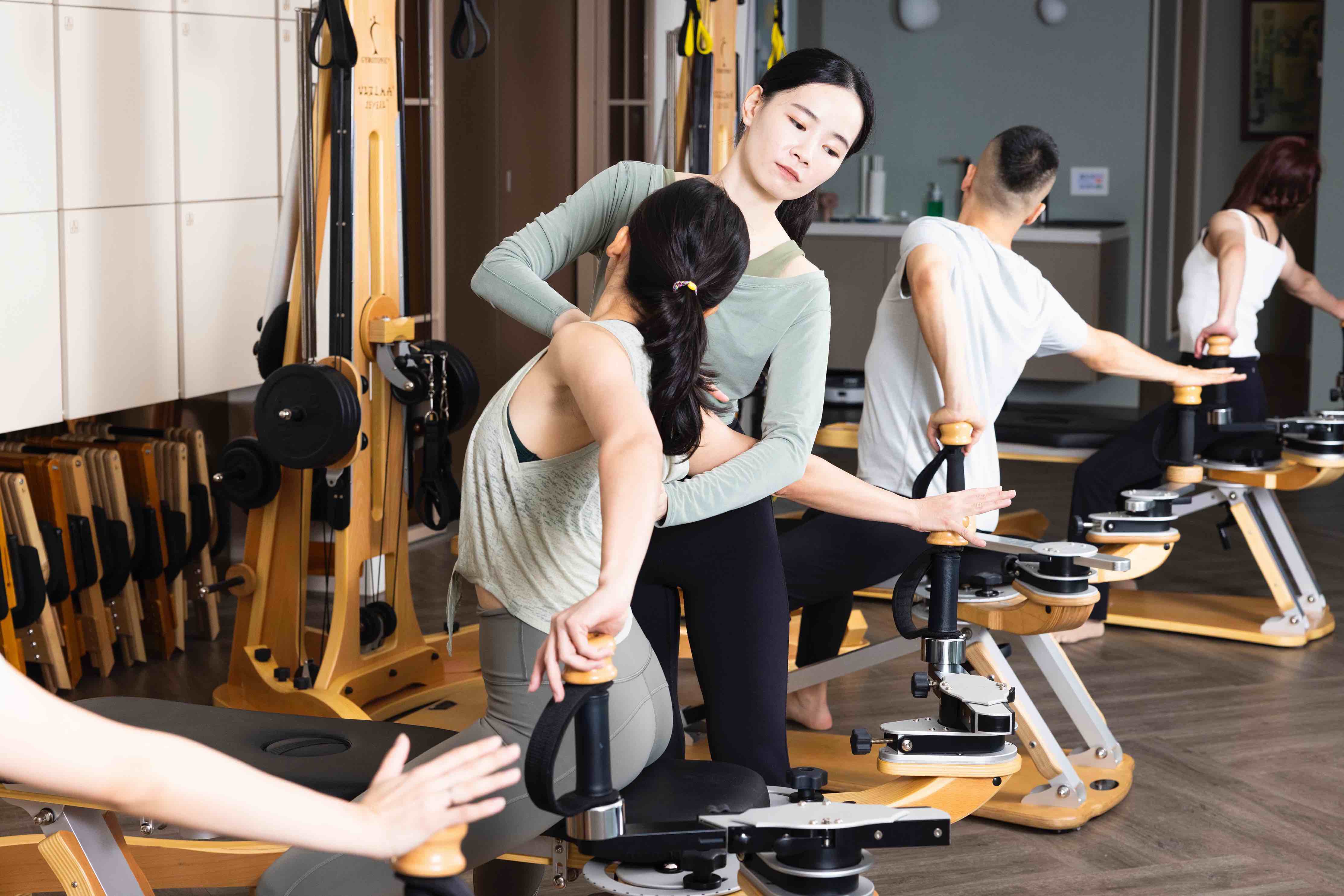
There is a very interesting phenomenon.
When Westerners first encounter some of Chanrou's core concepts—the flow of energy, the power of spirals, and the unity of mind and body—they often need some time to understand these rather abstract ideas.
But many people from the East, when they hear these concepts for the first time, feel a sense of familiarity, as if they "seem to understand this."
The flow of Qi, its spiraling nature, and the unity of mind and body—these are not unfamiliar to people from the East. They have always existed in our culture, our traditions, and our way of looking at the body.
Although Chanrou was founded in New York by a Hungarian dancer, many of its core concepts resonate deeply with Eastern traditions. This resonance gives Chanrou a special sense of familiarity for people from the East.
"Qi" and "Energy": Different Names for the Same Thing
Juliu strongly emphasizes the concept of "energy"—the flow of energy, the blockage of energy, and the cleansing of the energy body. Juliu even talks about Kundalini, an energy concept originating from the Indian yoga tradition.
For Western scientific thinking, the concept of "energy flowing in the body" is sometimes something that needs to be adapted to. But for Easterners, it is almost common sense.
Because we have "qi".
The concept of Qi has existed in Eastern culture for thousands of years. Traditional Chinese medicine talks about Qi and blood, meridians, and the smooth flow and blockage of Qi; Tai Chi talks about guiding Qi with intention and sinking Qi to the Dantian; Qigong is even named directly after "Qi". "Where Qi is blocked, there is pain" and "When Qi and blood flow smoothly"—these are sayings that many Easterners have been exposed to since childhood.
When Chanrou says, "Energy flows in the body; blockages cause problems, while smooth flow brings health," what Easterners hear is almost entirely the language of "qi" (vital energy). This concept doesn't need to be convinced, because it's already in our cultural DNA.
Spiral: The Core of Eastern Body Wisdom
The most representative movement characteristic of Chanrou is the spiral. It believes that the body is designed for spirals, and that truly efficient and powerful movements are spiral, not linear.
This is highly consistent with Eastern physical traditions.
Tai Chi Chuan is almost entirely built upon spirals and arcs—the "silk-reeling energy" refers precisely to that spiraling, winding power; Tai Chi movements are not straight, but entirely circular, arc-shaped, and spiraling. Baguazhang, in particular, centers on moving in circles, circling, and rotating.
Eastern martial arts and health traditions discovered the wisdom of the spiral long ago—the spiral can neutralize external forces, transmit power, and allow the body to generate powerful strength while remaining supple.
Therefore, when Chanrou emphasizes the spiral, it evokes a familiar wisdom for those who have practiced Tai Chi or have an affinity for Eastern body culture. Different systems, different languages, yet both point to the same truth about the body.
Mind-Body Unity: The East never separates mind and body.
Chanrou is a mind-body movement – it never separates physical training from psychological, emotional, and spiritual states. Movement, breathing, awareness, and emotional release are all integrated in Chanrou.
This concept of "body and mind as one" has only recently gained renewed attention in the West. The mainstream Western tradition has long viewed the body and mind as separate entities—the body is the body, and the mind is the mind, handled by different disciplines.
But the East has never divided things like this before.
In Eastern traditions, the body and mind have always been considered one. Traditional Chinese medicine emphasizes the unity of form and spirit, believing that emotions directly affect the internal organs (anger injures the liver, worry injures the spleen, and fear injures the kidneys); Zen meditation emphasizes the unity of body and mind; and yoga emphasizes the unity of body, breath, and mind. In the Eastern worldview, the body is not a machine separate from the mind, but rather an integrated whole closely intertwined with emotions, spirit, and consciousness.
So when Chanrou says, "A movement can release a stored emotion" and "Physical tension and psychological pressure are connected," Easterners don't find it mysterious—because this is how our tradition has always understood the body.
Breathing: The Common Core of Eastern Spiritual Practices
Chanrou places breathing at the very core of her art. Every movement is integrated with a specific breath; the breath guides the movement, and the movement guides the breath.
And breathing is at the core of almost all Eastern spiritual traditions.
Qigong emphasizes breathing exercises, Tai Chi emphasizes regulating the body through breath, Yoga emphasizes pranayama (breath control), Zen meditation emphasizes observing the breath, and Taoism emphasizes embryonic breathing. "Breath control"—regulating the state of body and mind through breathing—is a common wisdom of Eastern spiritual practice for thousands of years.
Chanrou's emphasis on breathing is entirely understandable, even familiar, to those with an Eastern spiritual background or who are familiar with these traditions. Using breathing to regulate the nervous system, guide energy, and connect the mind and body—these are things that Easterners have long known.
Flow and Nature: The Influence of Taoism
Chanrou also has a core principle—to adapt, not to resist. It means cooperating with gravity, with the body's natural structure, and with the universal laws of physics. It pursues efficiency and harmony, not brute force and conquest.
This spirit is almost a physical version of Taoist thought.
Taoism speaks of "following the natural way," "non-action," and "the highest good is like water"—not passive inaction, but rather conforming to the inherent laws of things, operating in the most effortless and harmonious way. The image of water is especially important in Taoism—soft, flowing, and adaptable, yet capable of penetrating the hardest things.
What Chanrou pursues is precisely this quality of being "like water"—flowing, adaptable, and overcoming strength with gentleness. When Chanrou says, "Don't resist, go with the flow," and "Achieve the most with the least amount of effort," it is almost a manifestation of Taoist wisdom in her body.
A beautiful coincidence where East meets West
Interestingly, Juliu Horvath did not intentionally "imitate" Eastern traditions when creating Chanrou.
He was an injured dancer who gradually developed this method through a long process of self-exploration and physical experimentation. He started with his own body and the essence of movement to find the most efficient, healing, and liberating way of moving the body.
What he ultimately found coincided with the wisdom of the body accumulated over thousands of years in the East.
This perhaps illustrates one thing: the truth about the body is universal. No matter where you start—whether it's Eastern martial arts and wellness practices or Western dance and body exploration—as long as you delve deeply and honestly enough into the essence of the body, you will eventually arrive at some common destination.
The power of spirals, the flow of energy, the unity of mind and body, the wisdom of breathing, the harmony of following nature—these belong neither to the East nor the West. They belong to the body itself.
This resonance is an advantage of Easterners learning gentleness.
For Easterners, this cultural resonance is actually an advantage in learning from Chanrou.
When a concept resonates with your cultural background, you understand, accept, and experience it much faster. You don't need to overcome the resistance of "this statement is strange" first, because it is inherently connected to your familiar worldview.
When Chanrou talks about energy, you think of Qi (vital energy). When she talks about spirals, you think of Tai Chi (the cosmic principle). When she talks about the unity of body and mind, you think of the unity of form and spirit. When she talks about following nature, you think of the Tao (the Way) of nature.
These connections make Chanrou not a completely unfamiliar foreign system to Easterners, but rather a reinterpretation of the bodily wisdom we are already familiar with using a new language and new methods.
Chanrou comes from the West, but many of the things she talks about—the bodies and culture of Easterners—have always been known.
Perhaps this is why, when people from the East visit Chanrou, they often have a peculiar feeling—
This method from afar speaks a language that we inherently understand.