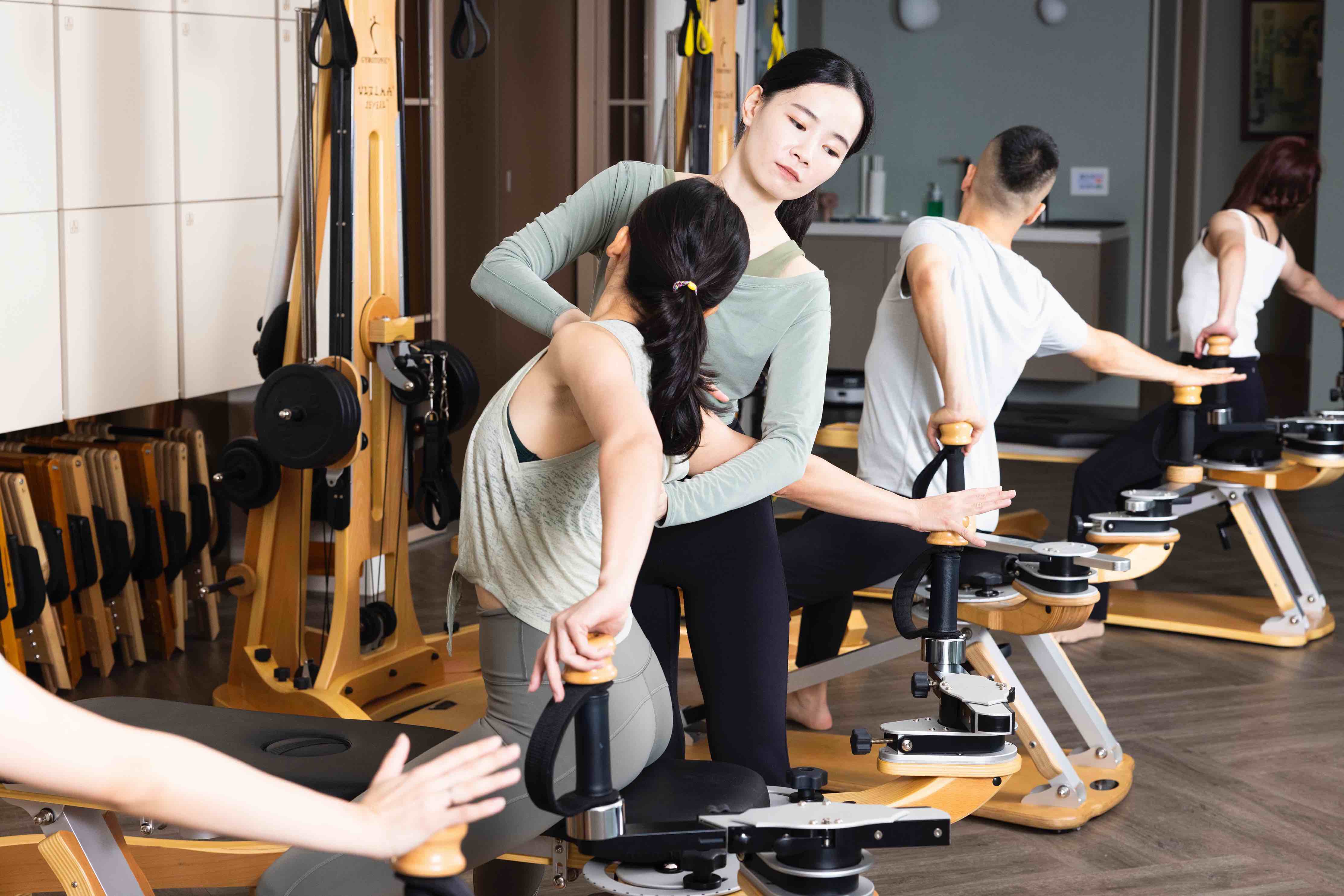
This is not an illusion.
Many people have a strange feeling when they leave the classroom after their first Chanrou class—it's as if they've grown a little taller. Their shoulders feel relaxed, their heads feel closer to the ceiling, and their steps are lighter than when they came in.
This feeling is difficult to describe clearly in words. But almost everyone who has practiced Chanrou has had a similar experience.
So what exactly happened?
You didn't actually grow taller, but your spine regained its space.
An adult's height is determined by their skeletal structure. A single dermatology class will not make your bones grow longer.
But your height is not just the length of your bones.
The spine consists of 33 vertebrae, with intervertebral discs acting as cushioning between them. Ideally, these discs are saturated with water and elastic, allowing the spine to maintain its proper length and curvature.
But in real life, prolonged sitting, looking down, and gravity—these factors constantly compress the spine. The intervertebral discs are squeezed, the internal fluid is squeezed out, and the spaces between the vertebrae narrow. You are not aware of this process, but it is constantly happening.
Studies show that a person's height can be 1 to 2 centimeters shorter at the end of the day than in the morning—this is entirely due to gravity compressing the spine.
What Chanrou did was to return these compressed spaces to the spine.
Intervertebral disc decompression: the real mechanism of height increase
One of the core principles of Chanrou is called Lengthening through Opposition.
Its logic is simple: the top of the head extends upwards, the tailbone sinks downwards, and the spine is gently lengthened between the tensions at these two ends. It is not pulled by external force, but rather the body actively creates space for itself.
This two-way pulling force creates a vacuum effect—reducing pressure within the intervertebral discs and allowing them to reabsorb moisture and regain their thickness. When each vertebra regains a few millimeters of space, the entire spine, visually and physically, will appear to have a height difference of 1 to 2 centimeters.
Many practitioners describe feeling an immediate lengthening in their back and an upward pull on their head after the session, as if they have "grown taller." They describe this as a feeling of "energy flowing upward"—not simply a postural adjustment, but a sensation of the spine being stretched internally. This description is actually quite accurate.
Once the fascia is loosened, the posture will naturally return.
In addition to decompressing the intervertebral disc, Chanrou did something else: she restored the flow of fascia.
Fascia is a network of connective tissue that covers the entire body, like a tight-fitting garment. When you maintain a fixed posture for a long time, the fascia begins to adhere, "fixing" you in that posture—the fascia of a hunchback will cause his body to tend to continue to hunch; the fascia of a person with a forward head posture will cause his head to continue to lean forward.
Chanrou not only trains muscles but also emphasizes the stretching and contraction circulation of fascia. Spiral and wave movements gently move the fascia from multiple directions, opening up adhesions caused by prolonged sitting, improving the connection between the limbs and torso, and increasing the range of motion. When the fascia in the chest loosens, the shoulders naturally fall back; when the fascia in the neck loosens, the head naturally returns to the top of the spine; when the fascia in the lower back loosens, the natural curve of the spine reappears.
These changes are not something you deliberately "stretch" out, but rather the body's natural readjustment after the fascia loosens. The overall feeling is lighter and more slender, naturally creating the sensation of "getting longer and taller."
The deep muscle groups are activated, and the surface muscles no longer need to exert force.
Many people's hunchback and reduced height are not caused by skeletal structure, but by an imbalance in muscles.
Deep stabilizing muscle groups—pelvic floor muscles, multifidus muscles, and transverse abdominis muscles—are responsible for supporting the spine from the inside. When these muscle groups fail, the spine loses its internal support, and the body compensates with large superficial muscle groups—shoulders shrug, back muscles strain to hold on, and neck juts forward.
This compensation not only consumes energy, but also causes the spine to be continuously compressed.
Chanrou's Seed Center training and pelvic narrowing techniques reactivate this deep system. When the deep muscle groups take over, the excessive tension in the surface muscles loosens, the shoulders naturally relax, the head returns to the correct position, and the body's center of gravity realigns—from the outside, it looks like a person has suddenly "stood up."
The breath deepened, and the chest opened up.
Chanrou feels "taller" after practicing, and there's another often overlooked reason: breathing.
Many people breathe very shallowly for a long time, using only the upper third of their chest cavity, with their ribs barely moving. This keeps the chest cavity in a state of slight contraction, causing the spine to be pressed forward, making the whole person look smaller and more shrunken.
Chanrou's breathing exercises truly engage the diaphragm—when inhaling, the ribs expand in all directions, gently stretching the spine within this expansion; when exhaling, the abdomen contracts, naturally engaging the core. As the amplitude of breathing increases and the chest cavity opens, the posture of the entire upper body changes accordingly.
Many people say that their breathing has become smoother after practicing Chanrou. This is not just a psychological feeling—it means that there is really more space in the chest cavity.
How long can this feeling last?
Honest answer: At first, it might only last a few hours.
You walk out of the classroom and feel taller and lighter. But when you return to your desk and your old posture and habits, your body may slowly return to its familiar state.
But this was not a waste of effort.
Each Chanrou exercise strengthens new neural circuits, telling the body, "This is the proper alignment for you." Over time, this new state begins to permeate daily life—the way you sit changes, the way you walk changes, and even your sleeping posture begins to change.
Many students who have been practicing Chanrou regularly for several months say, "When I walk down the street now, I suddenly realize that I'm straight. It's not because I'm consciously trying to straighten up; it's just how my body is."
That's how Chanrou truly works.