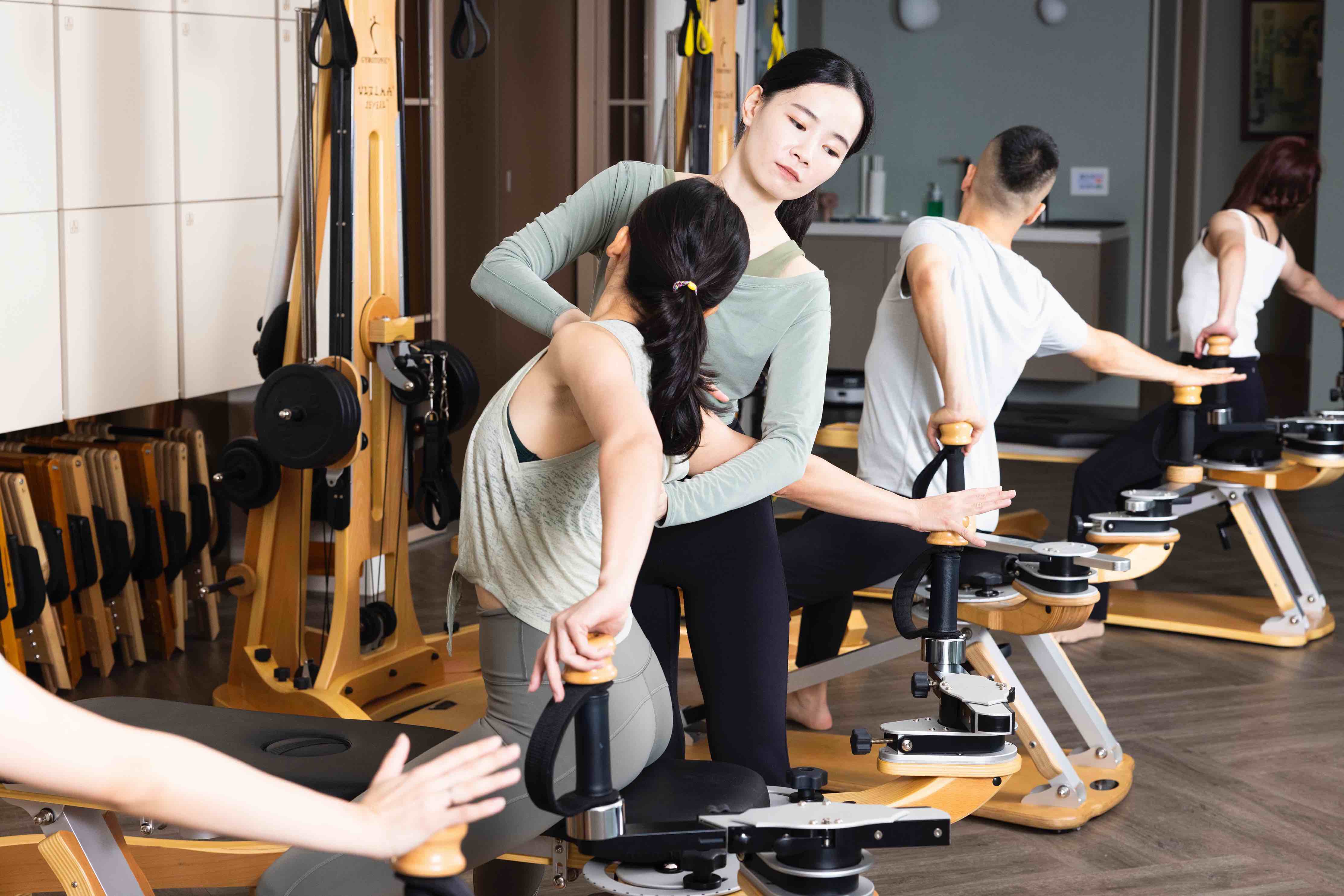
People taking GYROTONIC® and GYROKINESIS®'s class for the first time often have a question:
"Teacher, should I use more force?"
Teacher GYROTONIC® and GYROKINESIS®'s answer is usually not "yes" or "no," but rather: "Just let the action happen."
This answer is incomprehensible to many. From a young age, we're taught the logic of exercise: to see results, you have to exert effort. No pain, no gain. If you don't feel sore after a workout, it means you haven't worked out.
GYROTONIC® and GYROKINESIS®'s logic is the complete opposite of this.
What's the problem with "using force"?
First, let's clarify one thing: chin-twisting is not a low-intensity exercise. It can be very challenging, leaving you sweating profusely and your muscles extremely fatigued.
But the strength that GYROTONIC® and GYROKINESIS® pursues is not achieved through brute force.
When you "exert force"—especially the kind of force that involves tensing your entire body and clenching your teeth—several things happen simultaneously: your breathing stops or becomes very shallow. It's not just the "target muscle group" that contracts; all the surrounding muscles tense up, including those that should remain relaxed. The nervous system goes on alert, with the sympathetic nervous system taking over, and the body perceives a threat.
The more fundamental problem is that brute force is usually an "inward collapse" contraction, shortening muscle length and squeezing joints—like two pieces of dry, hard wood rubbing against each other. The intense contraction of local muscles squeezes the joints, and the force is canceled out during transmission, just like a car with the handbrake on, where pressing the accelerator harder will have a diminishing return.
What GYROTONIC® and GYROKINESIS® wanted was "efficiency".
What GYROTONIC® and GYROKINESIS® pursues is to find the most efficient path of movement—to complete the highest quality movement with the least amount of effort.
This is based on the principle of tensiongrity: when the tension of the whole body is evenly distributed, the force can be smoothly transmitted along the fascial chain, rather than being canceled out by local tension.
GYROTONIC® and GYROKINESIS® uses a different kind of force—the logic of the whip.
When you stop gripping the handles so tightly and instead learn to transmit power through the undulation and antagonistic extension of your spine, your body becomes like a whip. The end of the whip has immense power, but the point of force application is extremely elegant and effortless. This is why after practicing, you feel refreshed rather than exhausted.
Intention is more powerful than force.
GYROTONIC® and GYROKINESIS®li has a core concept called Intention.
Intention is not "imagination" or "pretending," but a clear neural command—before the action occurs, the brain already knows where the action is going, and the body is ready in that direction.
GYROTONIC® and GYROKINESIS®'s every movement begins with an intention: "Let the energy extend outward from the Seed Center," "Let the spine open up segment by segment from the tailbone to the top of the head," and "Let the weight of the arms be supported by the tension of the opposing extension."
These instructions aren't telling you to use a specific muscle, but rather they're telling the entire nervous system the direction and quality of the movement. When the nervous system receives a clear intention, the body automatically finds the most efficient way to achieve it.
Radiation from the inside out: the physical logic of a long lever
There is also a physical explanation for GYROTONIC® and GYROKINESIS®'s effortless movement.
Brute force shortens muscles and compresses joints. GYROTONIC® and GYROKINESIS® practices radiating energy from the center outwards—driven by breath, allowing energy to radiate from the fifth line to the fingertips and toes, with muscles working in a "stretched" state.
Physics tells us that a longer lever can generate a greater torque. When your limbs are "stretched," it becomes easier to move the same resistance. This is why graceful movements appear elegant and fluid, but can actually generate tremendous force—because it uses the efficiency of a long lever, rather than the brute force of a short lever.
Create space for joints
Brute force makes joints rub against each other like two pieces of dry, hard wood; efficiency makes joints float in lubricating oil.
GYROTONIC® and GYROKINESIS® creates internal space for the joints through the pressure gradient generated by rhythmic breathing. This "hydraulic support" prevents the joints from jamming together, eliminates friction, and makes movements natural, smooth, and effortless.
When joints have space, you no longer need to rely on brute force to support the structure—the structure itself supports you.
Saving effort does not mean being relaxed.
Here is a very important distinction: saving effort does not mean being easy, and efficiency does not mean having no challenge.
A skilled swimmer may appear to swim with ease, but the energy and speed they expend far exceed those of a beginner struggling in the water. It's not that they don't exert themselves, but rather that every ounce of their strength is used effectively, with no energy wasted on futile struggles.
The same goes for GYROTONIC® and GYROKINESIS®. Many students say that the fatigue after a workout is different from the fatigue at the gym. The fatigue at the gym is the feeling of being "drained," while the fatigue at GYROTONIC® and GYROKINESIS® is the feeling of being "fully utilized"—the body is tired, but not the kind of exhaustion.
Exertion is actually a form of fear.
"Exerting force" is often not just a choice of action; it is the body's defense mechanism—due to fear, instability, or cramped internal space, the body subconsciously tightens, trying to create a sense of security through tension.
GYROTONIC® and GYROKINESIS®'s training teaches the body to trust.
Trust that your structure can support you, trust that your breathing can guide you, and trust that a balanced distribution of tension throughout the entire system is more stable and safer than localized tension.
Once this trust is established, brute force naturally disappears. It's not that you deliberately let go of it, but rather that your body no longer needs it.
True strength comes not from how much weight you can resist, but from how lightly and gracefully you can control your body.