The feeling when you step out of the cabin after a long flight—
Lower back pain, stiff back, swollen legs, a constricted neck, and a feeling of being compressed all over. You're just sitting, but your physical condition is worse than if you'd run a marathon.
This is not an illusion; it is something that is actually happening inside your body.
What does flying do to the body?
The effects of long-haul flights on the body are more extensive than most people realize.
During a flight lasting over ten hours, the spine is under constant pressure from both gravity and the cramped seat, causing the intervertebral discs to slowly lose fluid and the distance between the vertebrae to narrow. Prolonged stillness slows the flow of blood and lymph, especially in the lower limbs—the legs rely on calf muscle contractions to pump blood back to the heart, but this mechanism almost ceases to function while seated, resulting in swollen and heavy legs. Fascia gradually hardens in this fixed posture, with the neck tilted forward, hip joints flexed, and the chest cavity contracting—the feeling of being "unable to move" after disembarking is the fascia protesting. The cabin noise, pressure changes, and jet lag keep the sympathetic nervous system in a state of constant alert, causing the body to continuously expend energy even when "doing nothing."
How did GYROTONIC® and GYROKINESIS® repair her body after flying?
Spinal decompression: counteracting cabin gravity
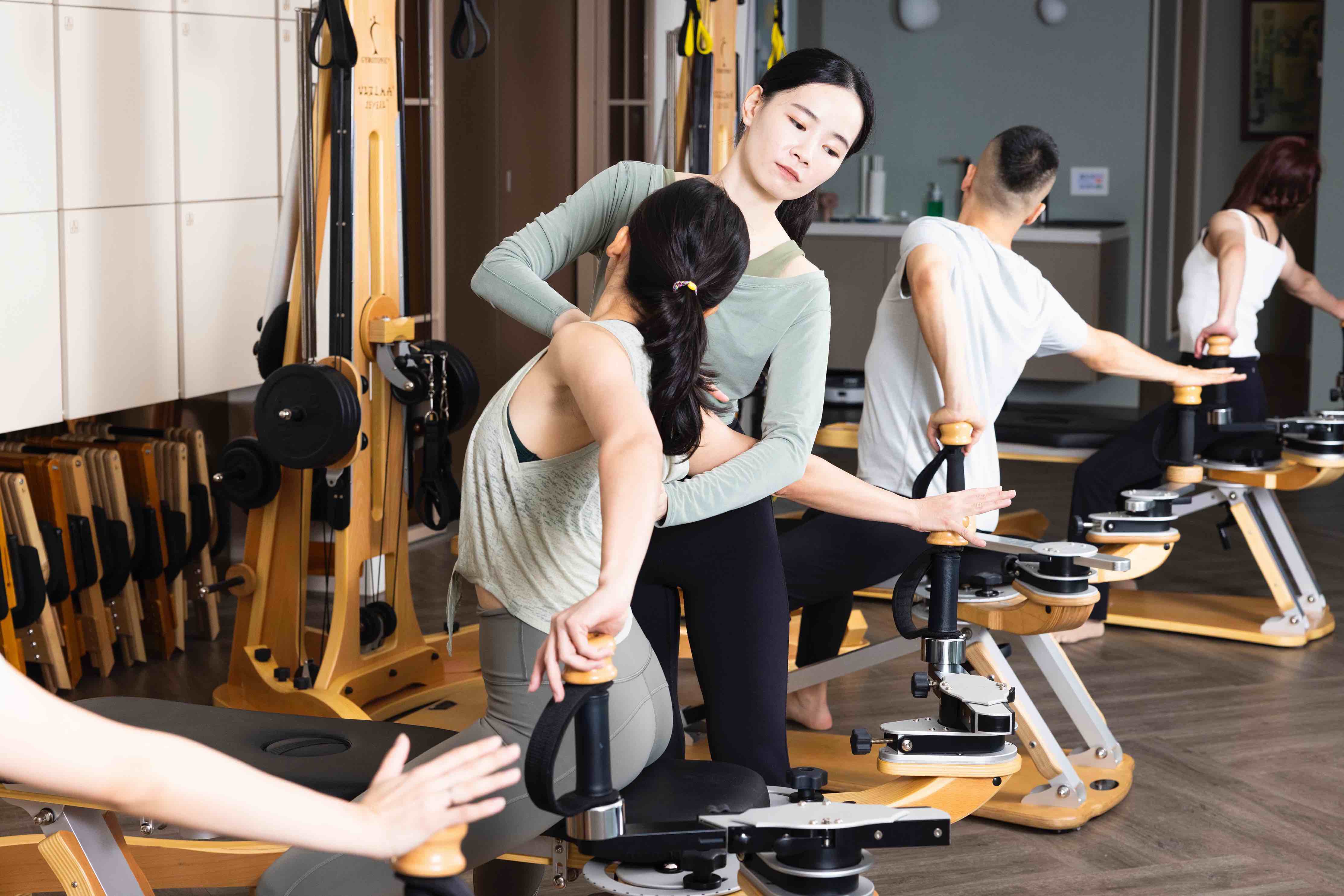
The gentle Arch & Curl – the extension and forward bend of the spine – is the most direct way to "decompress" after a flight. Through rhythmic undulations, it's like "inflating" the spine, combined with antagonistic extensions to reopen the compressed vertebral space. This isn't just simple stretching; it allows the intervertebral discs to reabsorb moisture and the vertebrae to regain their spacing, enabling you to quickly regain your original height and breathing ease after disembarking.
Release tension in the shoulders, neck, and chest.
Airplane seats are cramped, which can easily cause the shoulders and neck to tilt forward and the chest cavity to be compressed. Gentle spiral movements of the shoulders and thoracic spine can open the chest cavity, relax the shoulders, neck and upper back in a short time, deepen breathing, and reduce headaches and tension that are common after flying.
Bio-energy pump: Restarting the cycle
Rocking Pulsations—rhythmic pelvic undulations—are one of the most effective ways to activate the body's fluid circulation. The pelvic pulsation drives the spine in waves, acting like a biological pump to re-circulate lymph and venous blood. For those experiencing leg swelling after flying, this addresses the problem more fundamentally than wearing compression stockings—it doesn't just compress externally, but activates the body's own circulatory mechanisms from within.
Nervous System Reset: From Alertness to Repair
The gentle, rhythmic breathing and wave-like movements directly stimulate the vagus nerve, helping the parasympathetic nervous system take over. This allows the body to truly switch from the mildly alert state maintained during long flights to repair mode—many people have trouble sleeping after flying, not just because of jet lag, but also because their nervous system hasn't yet recovered from the tension in the cabin.
First, gently separate the adhered fascia and restore the joint spaces, allowing the body to return to its "aligned" state. Physical strength that would normally take three days to recover can be regained in just 60 minutes of exercise.
Recommended quick recovery procedure after flight (10–20 minutes)
The good news is that the mat version of GYROKINESIS® requires no equipment. All you need is a chair to perform simple and effective recovery exercises in a hotel room or airport lounge:
The chair-style spinal wave motion, combined with pelvic circles, opens up the spinal space compressed during flight. Then, a simple bio-energy pump is added to restart the body's circulation. Several spiral movements of the shoulders and neck release tension in the neck and upper back. Finally, several full diaphragmatic breaths allow the nervous system to truly descend.
GYROTONIC® and GYROKINESIS® is like a "body reset button" after a trip. It's not about high-intensity exertion, but a restorative flow—opening up the spine, restoring circulation, and reorganizing breathing, helping you quickly regain balance of mind and body after your trip.
Small movements during flight
Even inside the cabin, some principles of gentleness can be applied:
Every so often, gently feel the top of your head extend upwards and your tailbone root downwards, maintaining a slight length in your spine—no large movements are needed, just the intention. Circle your ankles, causing a slight contraction in your calf muscles to help maintain venous blood flow in your lower limbs. Every so often, take a few full, deep diaphragmatic breaths, allowing your chest cavity to not remain completely constricted.
Want to learn how to move around anytime, anywhere?
If you also want to learn this set of repair tools that require no equipment and can be used anytime, anywhere, the GYROKINESIS® Mat Instructor Training is the perfect starting point.
It's not just about learning the movements, but about truly understanding the logic of the body—why it breathes this way, why it vibrates this way, why it spirals this way—so that the body can regain its state in the shortest amount of time.
Once you learn this skill, you'll be able to use your own hands to reset your body, whether it's after a long flight, a long day of sitting, or when you're under a lot of stress.
KANISEUS® Level I Pre-Training Course Taipei AT Studio
July 10-15, 2026
Registration link:https://forms.gle/7RoV2kE81aynhm8A8
Before or after your next long flight, try GYROKINESIS® to make your body less prone to "getting stuck".