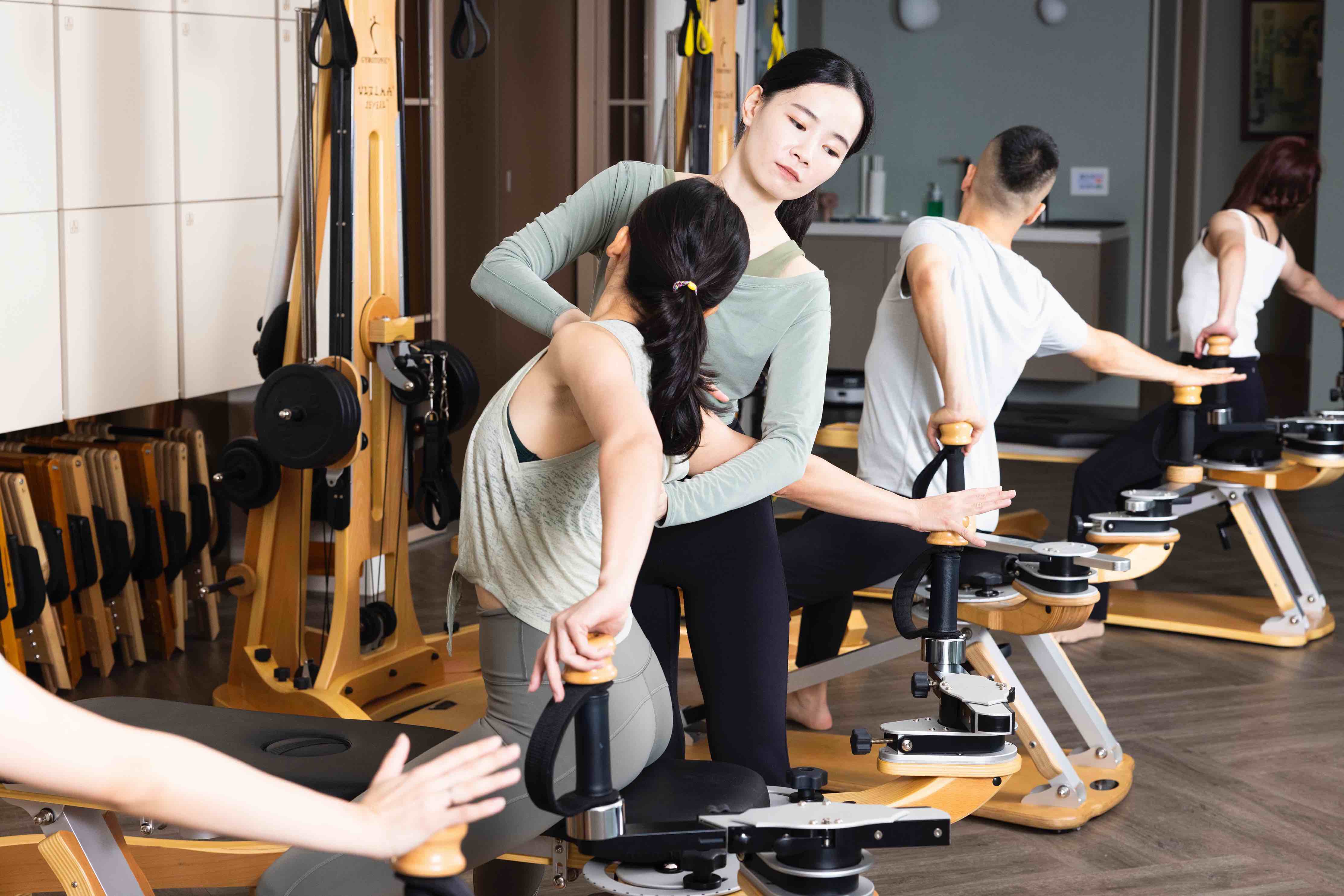
In Chanrou's class, "Create Space" is probably the phrase the teacher uses most often.
Many people think that relaxation is about "doing nothing." Lying down, closing your eyes, and letting your muscles relax—that's relaxation.
But if it were really that simple, why do so many people still lie in bed unable to sleep? Why do their neck and shoulder problems return the next day after a massage? Why is "trying to relax" more tiring for many people?
Because relaxation isn't just a matter of muscles. It's primarily a matter of space.
Without space, there is no relaxation.
Imagine a suitcase that's been packed too full. You try to rearrange the contents to make them more spacious—but the suitcase only has so much space, and no matter how you move it, the contents stay crammed together.
This is how many people's bodies are.
Prolonged stress, sedentary lifestyle, and poor posture can cause fascia adhesions, compress intervertebral discs, narrow joint spaces, and restrict breathing. In this state, muscles have nowhere to relax—they are squeezed into a space that is too small, and even if you tell them to relax, they don't know where to go.
True relaxation requires creating space first.
When there is space between joints and tissues, several things happen at the same time: muscles no longer need to tense up to maintain posture, breathing becomes deeper and smoother, chronic soreness and tightness are significantly reduced, movements become lighter and smoother, and the whole person feels "opened up".
Where does space come from?
Chanrou's understanding of "space" has several levels.
Joint space
Joints contain synovial fluid, which serves to lubricate and cushion the joint. When a joint is subjected to prolonged compression, the synovial fluid is squeezed out, causing the joint surfaces to rub against each other, reducing the range of motion and increasing pain.
The gentle lengthening through opposition allows the joints to be gently stretched apart in a balance of tension at both ends—the top of the head upwards, the tailbone downwards, and each intervertebral space of the spine regains its proper distance. This is not passive traction, but rather the space that the body actively creates for itself. At the same time, through the guidance of scooping, the tissues around the joints rediscover the space between each other.
When joints have space, muscles no longer need to strain to support a compressed structure, and they can truly relax.
space of fascia
Fascia is a network of connective tissue that covers the entire body. In a healthy state, it should be elastic and fluid—like freshly baked dough, soft yet taut.
When the fascia lacks multidirectional movement stimulation for a long period of time, it begins to dehydrate and stick, becoming like cold dough—hard, sticky, and losing its elasticity. This sticking not only restricts movement but also compresses nerves and blood vessels, making the whole body feel "stuck".
The gentle spiral and wave-like movements move the fascia softly from multiple directions, reopening areas of adhesion and allowing moisture to re-enter the tissue. Only when the fascia regains its fluidity can the "stuck" feeling in the whole body truly disappear.
Breathing space: Pushing open the walls from the inside
Many people's chest cavities are in a state of slight contraction for a long time - the ribs don't move much, the diaphragm is only used halfway, and breathing only occurs in the upper third of the lungs.
Chanrou connects movement with the depth of breathing. When inhaling, the expansion of the lungs and diaphragm pushes the ribs open from the inside—not just the front, but all directions at the same time; when exhaling, the outward radiating force maintains this space, preventing the chest cavity from collapsing immediately.
This "inside-out" space creates a direct stimulation of the vagus nerve located in the chest and abdominal cavities. When the internal organs have space to pulsate and function, the parasympathetic nervous system is activated, allowing us to enter a state of "dynamic tranquility"—the body is moving, but the nervous system is relaxed.
The "sufficiency" of the nervous system: space is a source of security.
A sense of space is not only physical, but also psychological.
When we feel depressed or anxious, our bodies instinctively shrink—our shoulders pull in, our chest collapses forward, and we become smaller. Conversely, when we actively expand the boundaries of our bodies, we are sending a clear message to our brains: "I am safe now."
Chanrou demands that the gaze and body extend to infinity. This sense of space breaks the contraction of the "fight or flight" pattern—when your body feels open, radiant, and unrestrained, the nervous system no longer needs to maintain a high state of alert.
This is why, after practicing Chanrou, students often feel not only physically lighter but also "more open-minded." The sense of space in the body directly translates into a sense of psychological freedom. In the flow of Chanrou, practitioners often feel that "their hearts have also opened up"—because this is not just a metaphor, but something that truly happens to the body and nervous system.
A sense of space is a form of body language.
Chanrou's teacher often uses the word "space" to guide the movements—"Make more space between your ribs," "Feel the opening between your shoulder blades," "Increase the distance between the top of your head and your tailbone."
This is not just a metaphor. It is about training a sense of body—allowing practitioners to begin to feel the space within their own bodies, to feel where things are compressed, where they are open, and where there is room for more.
When you develop this sense of space, you begin to feel it in your daily life—when sitting at your desk, you feel your chest contracting; when walking, you feel whether your spine is being compressed; when taking a deep breath, you feel where in your body is open and where it isn't.
This awareness allows you to create some space for yourself at any time.
Balance is not stillness, but a confrontation of spaces. Relaxation is not a loss of power, but a regaining of the leeway within the structure.
True relaxation is never the result of "doing nothing". It is something that happens naturally to the body after the space is created.