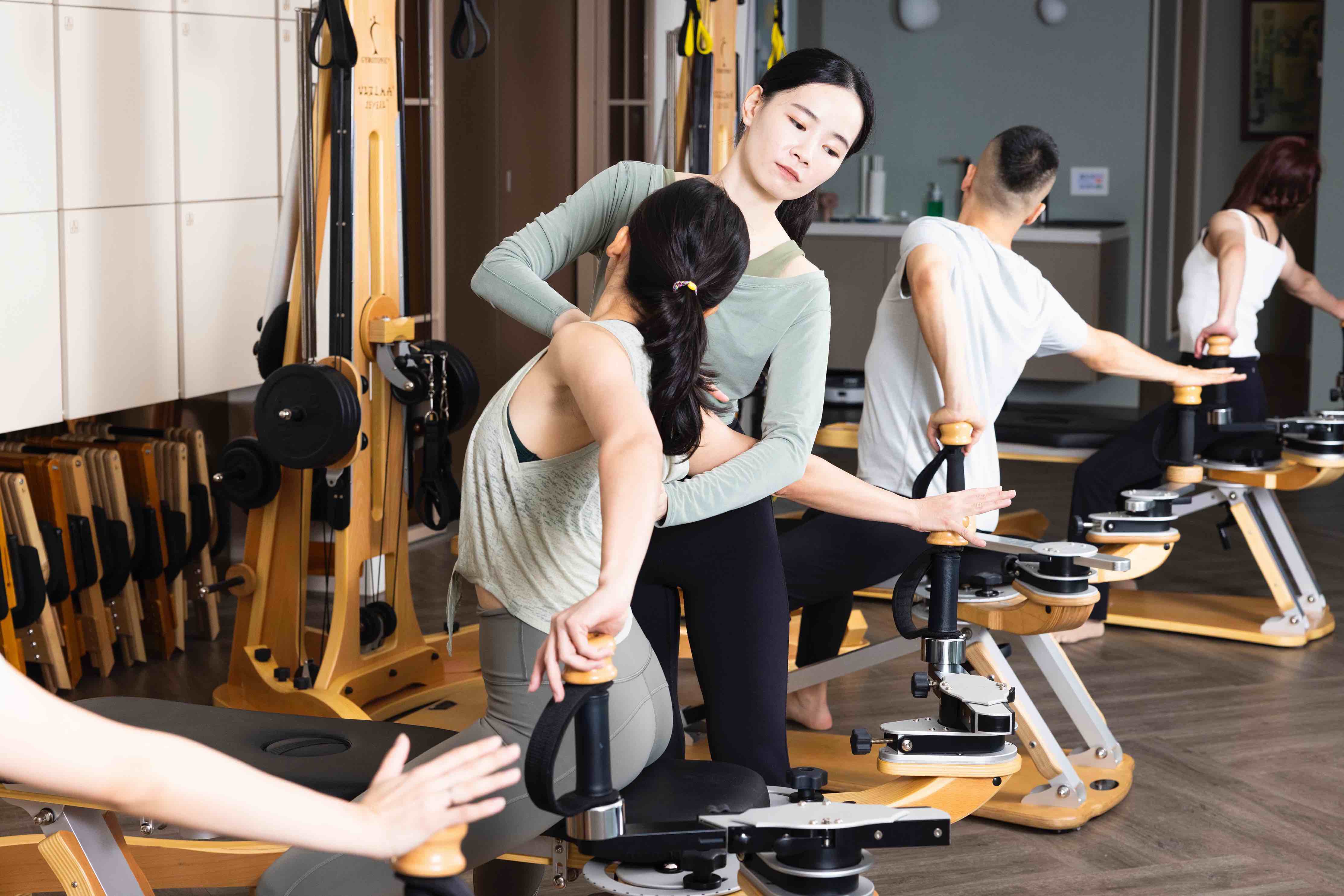
There is a type of teacher who teaches you movements.
There is a type of teacher who teaches you to feel the movement.
These two types of teachers may seem very similar in the classroom—both demonstrating, guiding, and correcting. But what students take away after class is completely different.
Action is the most superficial layer.
Many people come to Chanrou class hoping to learn a set of movements.
The teacher demonstrates, and the students follow along. If they do it correctly, they move on to the next one. If they make a mistake, the teacher corrects them. At the end of the course, you have learned a sequence.
The process itself is not wrong, but it only touches the very surface.
Actions are the result of bodily expression, not the starting point.
A truly good teacher like Chanrou doesn't just teach you the angle to raise your arms or the degree to which your spine should bend. She teaches you where that movement originates—from your breath, from the core of your being, and from your awareness of your own body.
When you only learn the outward form of an action, that action disappears outside the classroom. But when you learn the underlying logic that gives rise to that action, that logic will follow you into every corner of your life.
A good teacher teaches you to hear your own body.
Juliu, the founder of Chanrou, once said: "Theory does not create experience, experience creates theory."
A good teacher understands what that means. They don't turn the classroom into an anatomy lecture, using technical terms to tell you which muscle should contract when. They create an environment where your body discovers for itself how it should move.
This requires a very special teaching ability—not the ability to demonstrate movements, but the ability to guide perception.
Use an image to help the participant suddenly feel the deep support that has always been there but has never been felt. Use a touch to reconnect the participant's nervous system to a long-silent area. Use a sentence to help the participant let go of the anxiety of "Am I doing it right?" and truly enter the feeling of the present moment.
When this moment occurs—when the student suddenly says, "Ah, that's it"—it's not that the teacher taught anything; it's that the teacher created a space for the student's body to recall what it already knew.
Good teacher, seeing you is not just about your actions.
Everyone who walks into the classroom brings a different body, a different history, and a different present.
The same movement requires completely different guidance for someone with a shoulder injury and someone with a weak core. Similarly, the same class requires completely different rhythm and intensity for a student under a lot of pressure and someone in high spirits.
A good teacher's eyes don't just look at whether the movements are done correctly. They look at the person's state of mind that day—the way they breathe, the quality of their movements, and any unconscious hesitation or overexertion in a particular movement. They express more of these details than the students can say aloud.
Then he adjusted what he had given based on what he saw.
It's not a fixed course script, but a continuous, real-time dialogue.
A good teacher doesn't make you dependent on them.
This is the most counterintuitive thing.
The ultimate goal of a good teacher is to make themselves unnecessary.
It's not about giving up at the beginning, but about continuously returning control to the learners throughout the learning process. It's not about giving you the answers, but about teaching you to ask the right questions. It's not about correcting you every time, but about helping you gradually develop your own ability to distinguish between "right" and "wrong."
When a student leaves the classroom and enters into daily life, his teacher is no longer there. But if the teacher truly taught him perception, that perception will be there—in the way he walks, when he carries things, in the moment he feels his shoulders and neck begin to tense, he knows how to respond.
True learning is when you can continue even after the teacher is gone.
A good teacher, and I'm still learning myself.
This is the last thing, and perhaps the most important thing.
A truly good teacher like Chanrou never thinks she knows everything.
Dawnna Wayburne said, "Take your time and practice Progression 1 carefully. It's very powerful. Juliu's work is so powerful in its simplicity. You only need the foundation of his work, and you will become the teacher you want to be. You will get there."
A good teacher practices continuously because each practice session deepens their understanding of what they are teaching. A good teacher learns continuously because they know the system's depth far exceeds what any one person can fully grasp in a lifetime.
This humility is not a lack of self-confidence, but a genuine understanding—the wisdom of the body is infinite, and learning has no end.
Students can feel it. When a teacher is still on their own journey, when what they teach is something they are truly living with, not just something they have memorized—the quality of that class is completely different.
Good teachers teach more than just actions.
What he teaches is a way of getting along with one's own body.
A listening ability, a curious attitude, and the patience to neither give up nor force things when you can't do them.
These are the things that, once taken from the classroom, truly change one's life.