Our imagination of power is almost always contracted.
Lifting heavy objects, your biceps bulge. Sprinting, your leg muscles squeeze tightly. Doing a plank, your whole body tenses and holds. In our intuition, strength equals muscle contraction, equals squeezing a certain spot.
But if you observe the first action a cat takes when it wakes up, you'll see a completely different logic.
It doesn't contract; it extends. From the tips of its claws to its tail, its entire body stretches outwards, its spine elongates, its limbs extend, and at that moment, its whole body seems to be pulled apart by two opposing forces simultaneously. There's a sense of power in that movement that's comforting to watch—not tense, but full and expansive.
Chanrou's view of power is closer to that of the cat.
The cost of contraction
Traditional strength training is based on the premise that the stronger the muscles, the better they can resist resistance, and the more powerful the body will be.
The logic is sound, but it only tells half the story.
When you train only contraction—repeatedly generating force in a shortened state—several things happen simultaneously. The resting length of the muscle gradually shortens, the surrounding fascia loses elasticity due to prolonged compression, and the joint, surrounded by these constricted tissues, gradually reduces its range of motion.
This is a pattern often seen in long-term weight trainers: muscle mass increases, but movements become stiff, they can't exert force at certain angles, and they occasionally get injured in an unintentional movement. The injured areas are often not the muscles they have trained diligently, but the neglected, inelastic tissues.
Power has accumulated, but fluidity has been lost.
How extension generates power
Let's go back to the cat.
As it extends, two opposing things happen simultaneously within its body: the extremities extend, while the center stabilizes. The claws and tail stretch outwards, while a tension that draws inwards is maintained deep within the spine. This interplay of forces creates a stability that doesn't require conscious effort.
This principle has a name in physics: tensegrity. It's a concept in architecture and engineering, describing a system that maintains its structure through tension rather than compression. A tent doesn't need a central pillar for support; it relies on the tension between the ropes and the fabric. A spider web doesn't need a frame; it relies on the tension distribution of each thread.
The human fascia system operates in a way that is very similar to this principle.
When you extend your body outward, you create a widespread tension throughout the fascial network. This tension isn't concentrated in a single muscle, but rather travels along the lines of the fascia, engaging the entire system. The result is that you generate greater overall body force with less localized effort.
That's why truly powerful movements don't look effortless. It's not because they don't actually require strength, but because the force is distributed evenly, with no single point of overexertion.
Chanrou's first principle
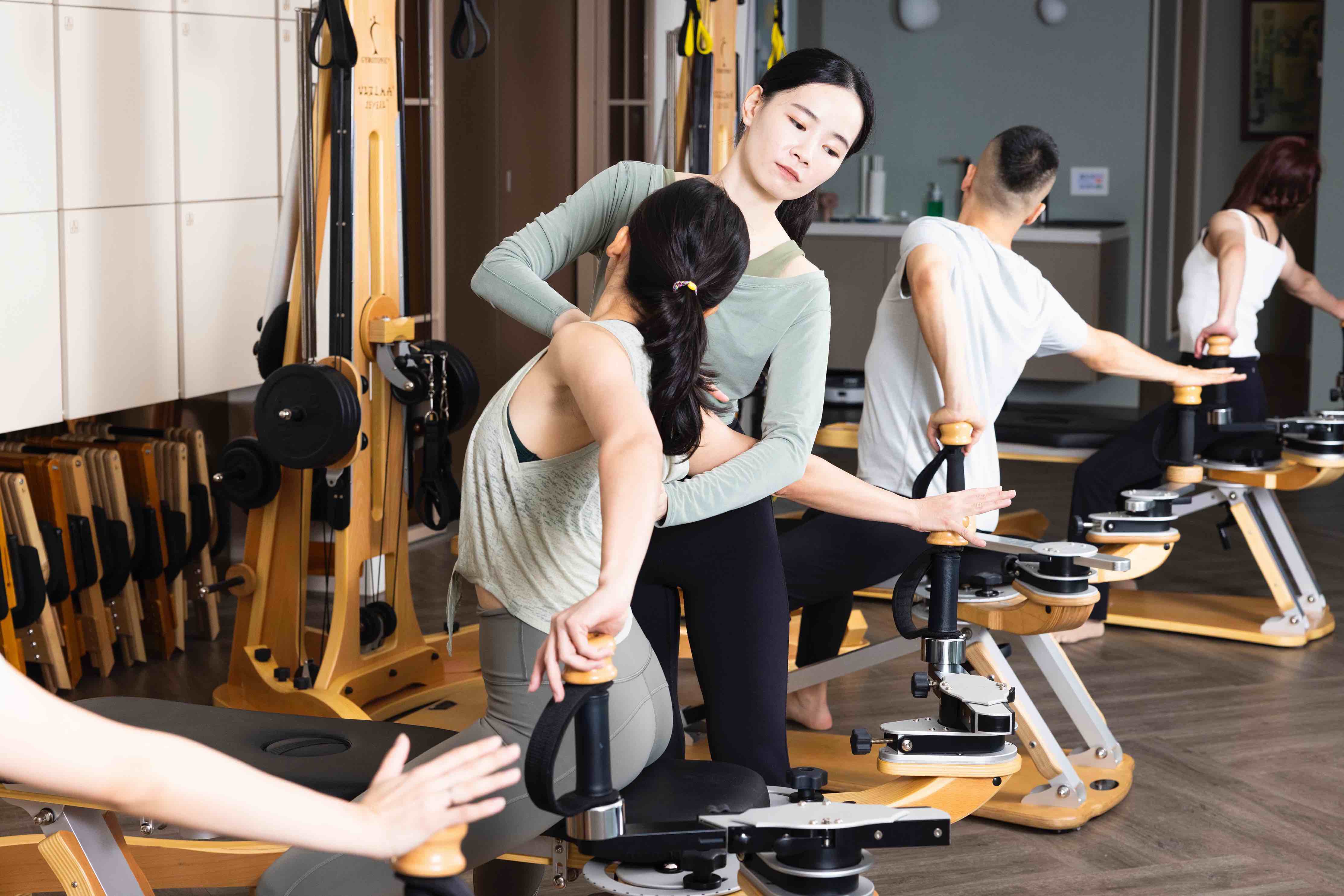
Chanrou places this concept at the core of the entire movement system.
Juliu Horvath observed that traditional strength training methods create significant muscle imbalances: agonist muscles become increasingly stronger, while antagonist muscles become increasingly passive, shorter, and less involved. Over time, this leads to distorted movement patterns, with some areas becoming overworked and others atrophying.
His solution was to extend both ends simultaneously.
In Chanrou's movements, almost no movement is unidirectional. As the hands extend upward, the feet extend downward. As the spine extends forward, the pelvis experiences a supporting tension backward. This bidirectional, simultaneous extension engages both ends of the body, activating the entire fascial chain.
This is not just about making movements smoother; it's actually training a different kind of strength—not the explosive power of muscles, but the tension integration ability of the entire system.
Flexible energy storage
Fascia has a property that muscles lack: it can store and release elastic energy.
When you stretch a rubber band, you store energy in its structure. When you release it, it doesn't just return to its original length; it springs forward, releasing a much greater force than if you had simply pushed it.
Well-trained fascia plays a similar role in human movement. When you move your body in an extended state, the fascia tissue is stretched, and elastic energy is stored within it. At the turning point of the movement—the moment from extension to contraction—this stored energy is released, generating a smooth, elastic force.
This is where the "flowing like clouds and water" feeling in Chanrou's movements comes from. It's not because it lacks power, but because the elastic energy of the fascia is skillfully utilized, making the movements appear light yet powerful.
Conversely, in a body where the fascia lacks elasticity, this energy storage mechanism fails. Every movement requires starting from scratch and relying solely on muscle force, without leverage or rebound, making it appear heavy and feel strenuous.
Space in the joint
The stretch also has another direct effect: it reduces pressure on the joints.
When the body tends to contract more than it extends, the tissues around the joints are in a state of compression for a long time, increasing the pressure on the joint surfaces and reducing the circulation of synovial fluid, which accelerates joint wear and tear over time.
Extended movements, especially those that "go around" the joint axis while maintaining length, can effectively reduce pressure on the joint surfaces, allowing synovial fluid to flow again and nourish the cartilage.
In Chanrou, there's a concept called "scooping"—scooping water. Instead of directly bending the joint, you imagine a circular track on the outside of the joint, and the limb moves along this track, rather than compressing inside the joint. This imagery accurately describes how extensible forces operate at the joint level.
If you do it right, you'll feel space in your joints, not pressure. Many people find that feeling unreal the first time they experience it, because they've never known that movement can be without pressure.
Redefining Strength
If strength is not just about contraction, then what is robustness?
Strength is the ability to integrate the power of the whole body in all directions and lengths, without relying on local compensation.
Strength comes from the coordinated engagement of all parts of the body during movement, rather than a few muscles exerting themselves while the rest of the body stands by and watches.
Strength is achieved when joints have space, fascia has elasticity, and movement is fluid; power output is based on this foundation.
This kind of strength isn't built by lifting heavier weights. It comes from quality—the quality of movement, the quality of awareness, and the continuous, mutually respectful tension between extension and contraction.
The cat isn't undergoing weight training. But when you watch it move, it doesn't seem weak.
That's what we're practicing.