After the massage, I felt light and refreshed as I walked out.
I woke up the next day and was back.
The weight on my shoulders and neck, the dull pain in my lower back, the tension in my back—they never really disappeared, they were just temporarily suppressed.
Many people have had this experience: they feel refreshed and relaxed after a massage, but the soreness returns the next day or a few days later. This is because massage is mostly an "external intervention," which can temporarily relieve muscle tension but doesn't change the body's natural usage patterns. When you return to your original posture and habits, the soreness naturally reappears.
This isn't because the massage therapist's technique is bad. It's because the massage addresses the symptoms, not the root cause.
The real cause of chronic aches and pains
Many people believe that chronic muscle aches and pains are simply a problem of "tight muscles." However, tightness is merely a symptom; there are usually three underlying issues occurring simultaneously:
The nervous system remains on high alert. When the body is under prolonged stress or in poor posture, the sympathetic nervous system remains activated, keeping the muscles in a state of slight, preparedness. This contraction is not something you can relax through willpower—it's a command at the nervous system level.
Fascial adhesion and dehydration. Fascia is a network of connective tissue that covers all the muscles and organs in the body. It requires continuous dynamic compression and release to maintain its moisture and elasticity. Prolonged fixed postures cause fascia to lose its fluidity and begin to adhere – a large part of soreness comes from the fascia, not just the muscles.
Compensation for action patterns. The body is very clever; it will continue to function without addressing the "uncomfortable areas." As a result, some parts are overworked for a long time, while others remain completely still. Once the compensatory pattern becomes ingrained, even if you loosen the tense areas, the body will tense up again due to old habits.
Massage can temporarily relax muscle tension, but it cannot retrain the nervous system, restore fascial fluidity, or change movement patterns. That's why the effects only last for a day.
Passive relaxation vs. active space
When we feel soreness, it's usually because the "space" between our skeleton and joints has disappeared. Prolonged sitting or incorrect posture can cause muscles to stiffen, like overworked steel cables, trying to hold up a collapsing skeleton.
Massage (passive) — It's as if external force is forcibly pushing the stiff muscles apart. Although it temporarily relieves the tension, the "underlying dynamics" that support the skeleton are still not activated. Once you return to your desk, your brain will immediately command the muscles to tense up again to prevent your body from collapsing.
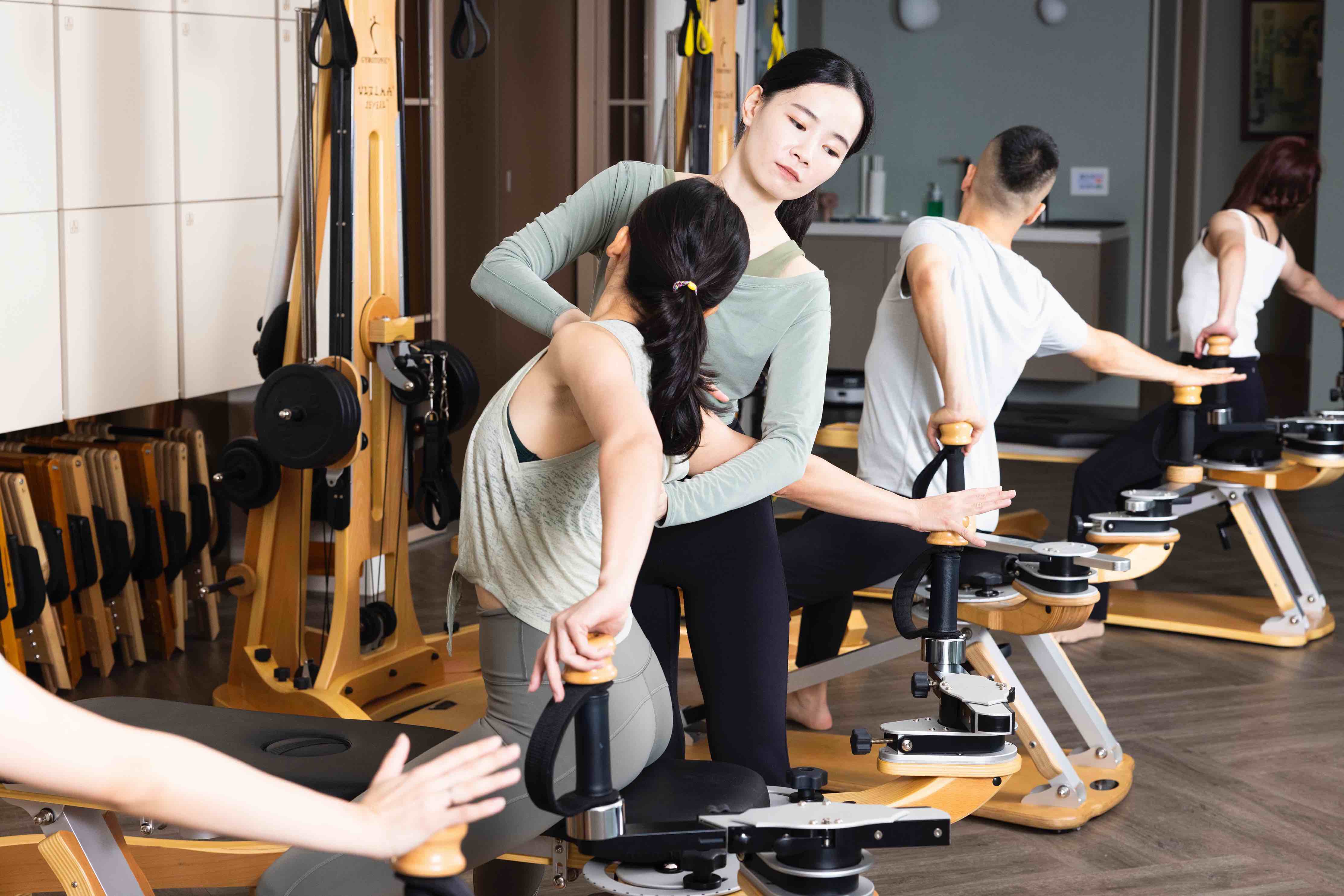
GYROTONIC® and GYROKINESIS® (proactive) — This teaches you how to "grow space" from within your body. Through Lengthening through Opposition, we don't push muscles apart, but rather widen the gaps between bones.
How does GYROTONIC® and GYROKINESIS® address chronic aches and pains at their root?
Active counter-stretching: "stretching" the fascia instead of "pressing" it open.
Massage involves applying external force downwards, while GYROTONIC® and GYROKINESIS® uses lengthening through opposition—the hands pull upwards and the legs extend downwards, simultaneously lengthening the spine. This active, multi-vector stretching penetrates deep into the fascia, releasing adhesions and chronic tension, allowing the body to "de-stress" on its own, with effects that last much longer than passive massage.
Fascia research indicates that the number of sensory nerve endings in the fascia is six times that in the muscles—many sensations we perceive as "muscle soreness" actually originate from the fascia. Only when the fascia regains its fluidity can that deep, dull pain truly dissipate.
Core Imbalance: The Hidden Root Cause of Chronic Aches and Pains
Another major cause of chronic aches and pains is an imbalance in core strength. GYROTONIC® and GYROKINESIS®'s unique Narrowing of the Pelvis technique activates the deepest supporting muscles. This strength acts like a natural "inner vest," supporting your spine from the bottom. When the skeletal structure has this active support, the neck and shoulder muscles, which were originally tense and responsible for compensation, naturally no longer need to overwork, and the aches and pains disappear.
Dynamic stability replaces rigid fixation
Many people believe that "keeping your core constantly engaged" will prevent pain, but this actually causes more soreness. GYROTONIC® and GYROKINESIS® uses "Stabilization through Contrast" to help you naturally generate stabilizing power while stretching. Once the Seed Center is activated, the entire body's movement chain is reconnected, and the muscles that were previously compensating no longer overwork, cutting off soreness at its source.
Start with the nervous system
The gentle, rhythmic breathing and wave-like movements directly stimulate the vagus nerve, allowing the parasympathetic nervous system to take over. Only when the nervous system returns to a state of alertness can the muscles truly relax—not by being pressed down, but by relaxing at the level of the nervous system itself.
Many students say that the feeling of relaxation after GYROTONIC® and GYROKINESIS® is different from that after a massage. A massage is about being "relaxed," while GYROTONIC® and GYROKINESIS® is about "relaxing on your own." This difference reflects whether the nervous system is truly involved.
Why can the effects of GYROTONIC® and GYROKINESIS® last?
The effects of a massage are short-lived because it doesn't change any habits. You return to the same chair, the same posture, and the same movements—your body naturally returns to its original state.
What makes GYROTONIC® and GYROKINESIS® different is that it trains your body memory.
Each practice session strengthens new neural connections. Each correct movement tells the body, "This is the correct way to use it." Over time, these new patterns begin to permeate daily life—the way you walk changes, your posture changes, even your breathing becomes different.
This is why GYROTONIC® and GYROKINESIS® students often say, "After practicing for a few months, my old ailments gradually disappeared. They weren't cured; they healed on their own."
Massage isn't bad, it's just not enough.
This article is not against massage. Massage has its value—relaxation, stress relief, and temporary pain relief.
But if you've been getting massages for years and the same problem persists, it's worth asking yourself: Do I need to continue relaxing, or do I need real change?
GYROTONIC® and GYROKINESIS® is the latter answer.
Chronic aches and pains are not what your body is like. It's a fixed pattern—and patterns can be changed.