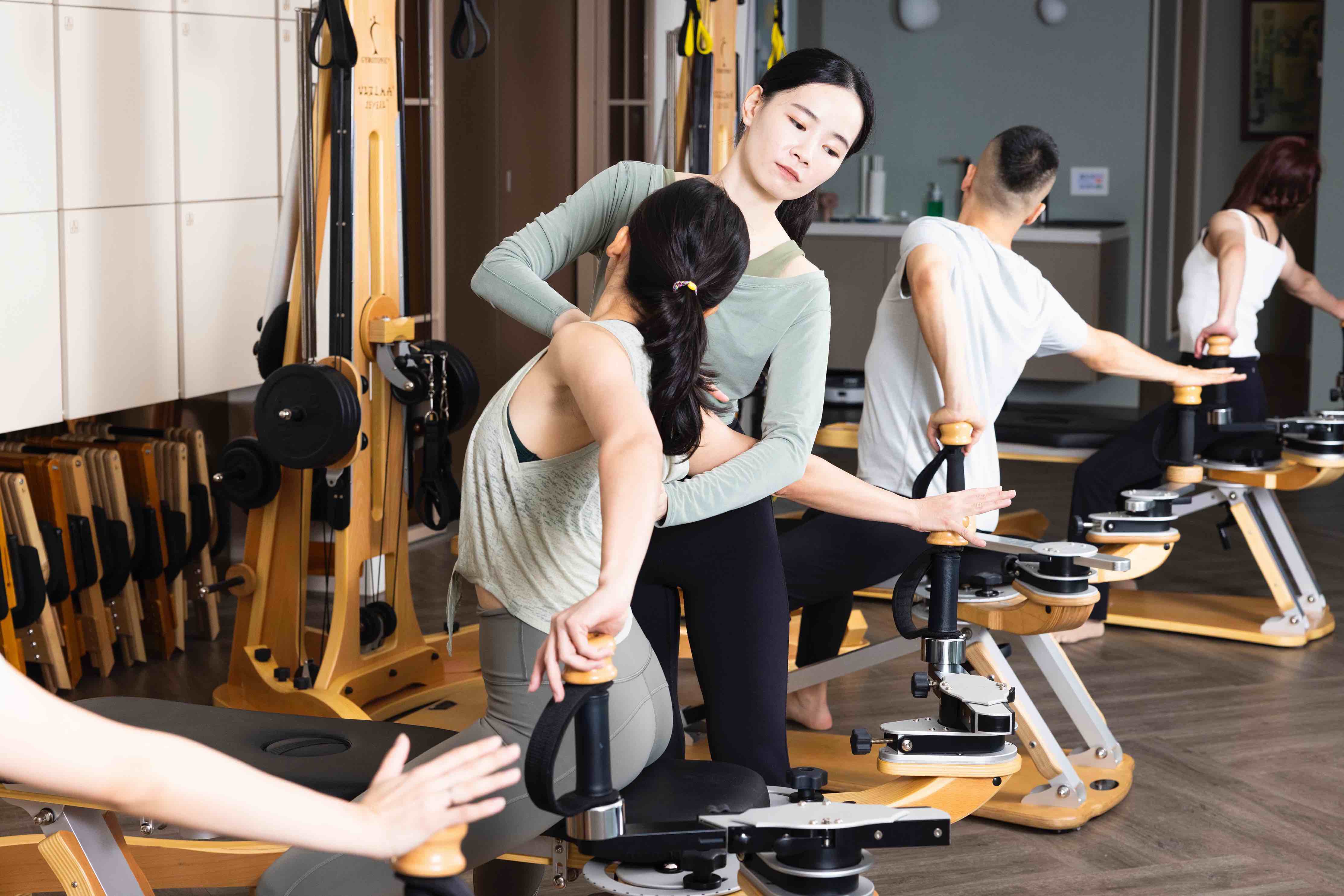
You may have been told from a young age that the skin is the largest organ in the human body.
This statement is correct in terms of area. But if we are talking about "sensation"—that is, the ability to detect bodily states and send messages back to the brain—there is another system of scale and importance that far exceeds that of the skin.
It is called fascia.
What is fascia?
Fascia is a network of connective tissue that covers the entire body.
It envelops every muscle, every organ, every bone, nerve, and blood vessel. It is not merely a thin membrane separating different structures; it is a continuous, three-dimensional, interconnected network of tension, without any breaks from head to toe.
You can think of it as a form-fitting, three-dimensional knitted garment, where every thread is connected to the others. When you pull on one corner, the tension of the entire garment changes. The same is true for the body's fascia: tension in the soles of the feet can travel down the lower back, tension in the neck can connect to the pelvic floor, and no part is truly isolated.
This connectivity allows fascia to play a role in the body's sensory system that many people don't realize.
Numbers speak for themselves
Studies show that the number of sensory nerve receptors in fascia is about six times that in muscles.
Six times.
This means that a large part of your brain's perception of your body's state comes from the fascia, rather than from the muscles. The primary source of information—body position, direction of movement, tension and pressure within tissues—is this network of connective tissue that runs throughout the body.
We tend to think of "sensation" as the work of the skin. But the skin primarily senses external stimuli—temperature, touch, and pain. The fascia senses the internal state—what shape your body is in, what movements you are making, where there is tension, and where adjustments are needed.
This is a completely different sensory ability, and its impact on the quality of your movements, body awareness, and even your emotional state is much greater than we previously thought.
The true source of proprioception
You don't need to look down at your feet when you walk; you know where your hands are; and you can feel your body posture even with your eyes closed.
This ability is called proprioception, commonly known as the body's "sixth sense".
Textbooks tell you that proprioception comes from muscle spindles in muscles and Golgi tendon organs in tendons. This is correct, but incomplete. The sensory receptors densely distributed in the fascia, especially Messner's corpuscles and Ruffini's terminals, also play a crucial role in the construction of proprioception.
More importantly, the sensory receptors in the fascia are particularly sensitive to "slow, sustained changes in tension." This means that rapid, explosive movements are not their forte, but slow, conscious stretching and movement can stimulate these receptors in a way that rapid movements cannot, allowing the brain to have a clearer grasp of the body.
This point is crucial to understanding the effects of Chanrou.
What happens when fascia is adhered?
Fascia is a living tissue; it needs movement to maintain its health.
When the body lacks multi-directional activity for a prolonged period, or when tissues have not fully recovered from an old injury, the layers of fascia can begin to adhere. These adhesions may not be painful, but they can restrict the range of motion, reduce the efficiency of sensory receptors within the fascia, and blur the brain's perception of the affected area.
Proprioception is thus diminished. You're unsure where that part is or what it's doing. To cope with this uncertainty, the brain increases protective muscle tension in that area, further restricting movement and creating another vicious cycle.
This is why you "can't feel" certain areas that have been under tension for a long time when you press them. It's not that they've gone numb, but rather that the communication pathways between the brain and that area have become unclear due to long-term adhesion and protective tension.
What Chanrou is doing is actually rebuilding communication.
From a fascial perspective, Chanrou's movement logic becomes very clear.
The slow speed allows sufficient time for the sensory receptors in the fascia to be stimulated and respond. These receptors are most sensitive to slow, sustained-tension stimulation; rapid, swinging motions are almost transparent to them.
Multidirectional movement allows different parts of the fascial network to be pulled in turn, preventing adhesions from forming due to neglect in any one direction over a long period. Healthy fascia needs to be used in all directions.
The "intention" before each movement, that is, feeling the direction in your mind before moving your body, is actually actively activating the neural pathway from the brain to the body, so that the following movement involves more conscious participation.
These three things combined do more than just make muscles stronger or more flexible; they rebuild the brain's complete perceptual image of the body.
As the image becomes clearer, your movements become smoother, your body awareness becomes more precise, and those areas that have been under long-term protective tension begin to have a chance to truly relax.
Perception can be trained.
Many people say they can't feel certain parts of their body moving when they first start practicing Chanrou.
The coach told them that a certain vertebra should move, but they felt nothing. The coach told them to try to feel if their right ribs opened up when they inhaled, but they were clueless.
This isn't a physical problem. It's that their sensory abilities, which haven't been used for a long time, have temporarily fallen into a dormant state.
But it can be awakened.
Typically, after a few classes, students begin to say, "I can feel it." This isn't because their bodies have suddenly changed, but because the sensory receptors in their fascia are being stimulated regularly, and their brains are receiving more information from that area, increasing the resolution of their perception.
That moment of "I feel it" is often memorable because it's not just a physical sensation, but also a feeling of reconnecting with oneself.
You haven't lost it, you just haven't used it for a long time.
Once you use it, it will come back.