Most people's understanding of the diaphragm is limited to the level of "the muscles that breathe".
It descends as you inhale and rises as you exhale, allowing your lungs room to inflate and deflate. This is the textbook version, and the image that comes to mind for most people when they hear the word "diaphragm."
But the diaphragm does much more than that.
It is the ceiling of your core system. Its position, its tension, and its activity patterns have a direct impact on your posture, your spinal stability, and your abdominal pressure.
When the diaphragm malfunctions, the entire body's tissue structure is affected.
Your core isn't just your abs.
The phrase "training the core" has been overused, but most people's understanding of the core is actually very one-sided.
The true core is a three-dimensional container composed of four sides: the front and sides are the deep abdominal muscles, the back is the multifidus and erector spinae muscles, the bottom is the pelvic floor muscles, and the top is the diaphragm.
These four aspects must work in sync to provide true support for the spine.
Many people who practice so-called core training are actually only working the front layer. Sit-ups, planks, crunches—these exercises stimulate the rectus abdominis and transverse abdominis, but have limited impact on the diaphragm and pelvic floor muscles. As a result, the front wall of the core becomes stronger, but the coordination between the top and bottom doesn't keep up, and the whole container is still leaking.
A leaky container cannot truly stabilize the spine.
The relationship between the diaphragm and posture
The diaphragm attaches to the lumbar vertebrae and also to the lower edge of the ribs.
The location of this attachment point is crucial. It means that the tension and movement of the diaphragm directly affect the curvature of the lumbar spine and the position of the ribs, thus affecting the alignment of the entire upper body.
When the diaphragm functions properly, it descends and rises evenly during respiration, and the pressure in the abdominal cavity changes rhythmically between inhalation and exhalation. This pressure variation, in conjunction with the synergy of the pelvic floor muscles and deep abdominal muscles, forms a dynamic, self-regulating spinal support system.
You don't need to actively "contract your abdomen" or deliberately "clench your fists"; this system operates automatically as you breathe.
However, when the diaphragm's function is impaired, this automatic system malfunctions.
What causes problems with the diaphragm?
Several common conditions can affect the function of the diaphragm.
The first factor is prolonged shallow breathing. Prolonged sitting, chronic stress, and looking down for extended periods can easily lead to a habit of breathing primarily through the upper chest, with the diaphragm only engaging in minimal movement. Over time, this reduces its range of motion and decreases its coordination with surrounding tissues.
Secondly, there's the issue of ingrained posture. When the thoracic spine is chronically hunched over, the ribs tilt forward, the attachment angle of the diaphragm changes, and its mechanical efficiency decreases. It needs to exert more effort to complete the same task, or it simply relies on other muscles to compensate. These compensating muscles are usually the neck and upper trapezius muscles, which is why people with poor breathing function often have particularly tight necks and shoulders.
Thirdly, there is chronic abdominal tension. Many people's abdomens are in a state of hidden tension for a long time, sometimes due to anxiety about body imagery, and sometimes due to the unconscious urge to "tuck in" the abdomen. This tension restricts the downward movement of the diaphragm, making inhalation shallow and reducing the quality of the entire respiratory cycle.
A chain reaction you didn't notice
The most direct effect of poor diaphragmatic function is shallow breathing.
Breathing becomes shallower, reducing stimulation to the parasympathetic nervous system, making it harder for the body to truly recover from stress. This isn't a change you can feel; it happens slowly. You might just feel more tired lately, more easily stressed, and your sleep quality doesn't seem to be as good.
At the same time, reduced diaphragmatic activity makes abdominal pressure regulation less efficient. The lumbar spine loses internal support and begins to rely on the surrounding muscles to work harder to maintain stability. This is how chronic tension in the lower back develops—not because the lower back muscles are weak, but because they are compensating for a task that shouldn't be their responsibility.
The same applies to the neck. People with impaired diaphragmatic function tend to rely more on accessory respiratory muscles, namely the sternocleidomastoid and scalene muscles, when breathing. These muscles are normally only activated during strenuous exercise or emergencies, but when the diaphragm malfunctions, they become the main force for daily breathing. Over time, chronic neck tension and headaches become almost inevitable.
A problem with the diaphragm eventually manifests simultaneously in the neck, shoulders, and lower back. These are not three problems, but rather three aspects of one problem.
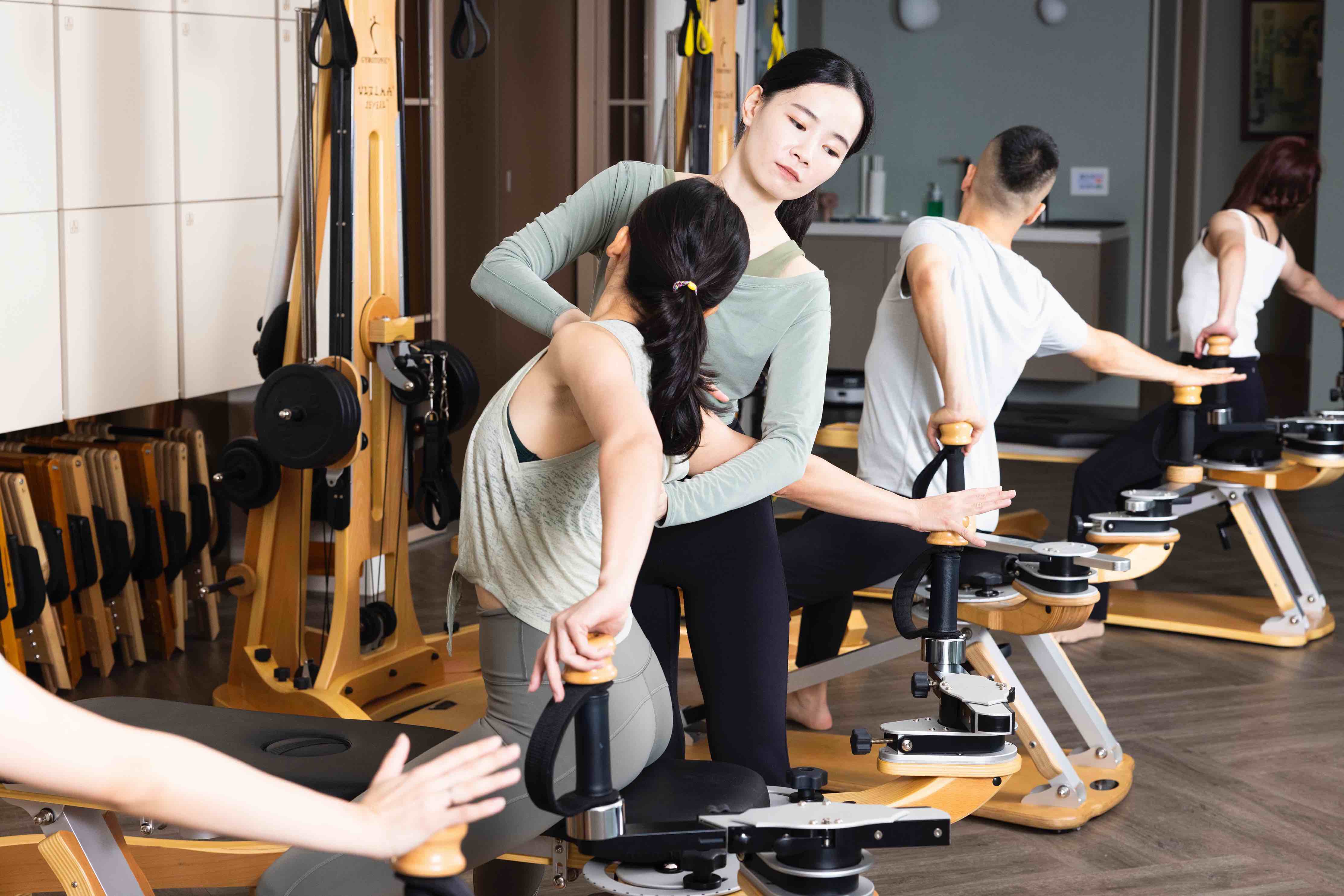
How did Chanrou re-teach the diaphragm?
Chanrou's requirements for breathing were not just about technical coordination from the very beginning.
It is re-establishing the activity pattern of the diaphragm.
Each movement is accompanied by a corresponding breathing rhythm, and this rhythm is three-dimensional. When inhaling, the ribs expand in all directions, not just forward, but also to the sides and backward. The diaphragm descends completely during this expansion, creating space in the abdominal cavity. When exhaling, this expansion slowly retracts, and the deep abdominal muscles are naturally engaged, not through conscious effort, but by following the airflow.
This complete three-dimensional breathing technique is something many people need to relearn. Their bodies haven't breathed this way in a long time.
Once this pattern is re-established, the changes extend beyond just breathing itself. The spine gains genuine internal support, allowing surrounding muscles to relax and compensate, and posture improves naturally without conscious effort. Tension in the neck and shoulders decreases, and chronic tension in the lower back gradually eases.
This is why those who practice Chanrou rarely only feel "a certain part of their body has improved." It is a systemic change because breathing is inherently a systemic process.
Next time you feel your waist is tight
Don't rush to stretch your waist.
First ask yourself: How has my breathing been lately?
Place your hands on either side of your ribs, take a breath, and feel if your ribs expand outwards, or if the inhalation only occurs in the upper chest. Try to let the air go down towards your abdomen, allowing the diaphragm to move fully.
When you exhale, don't rush it; let it be a little slower than your inhalation, allowing your abdomen to naturally retract.
Do it a few times.
You might find that the tension in your lower back has eased a little. This isn't because you did any stretching, but because you've allowed your diaphragm to return to its proper position, the core pressure has been redistributed, and your lower back muscles don't need to work as hard for a while.
That feeling is like the diaphragm working.
It has always been there, but many people have forgotten how to make it move.