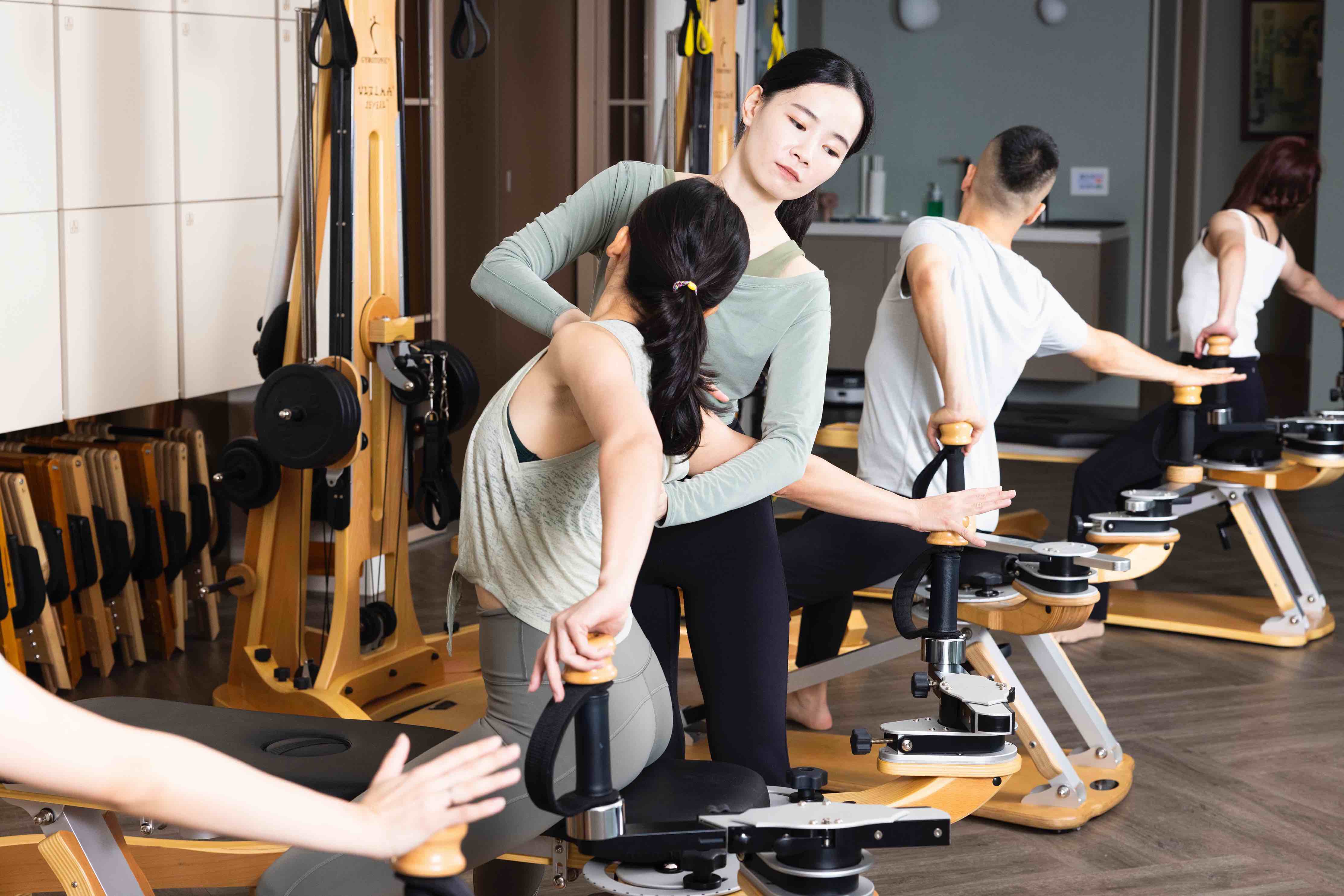
When some people first entered Chanrou's classroom and saw the equipment, they assumed it was some kind of fitness training.
Some people, seeing the fluidity of the movements, assumed it was a dance class.
Some people, upon hearing about its healing effects on the body, mistake it for rehabilitation.
These understandings are all correct, but none of them are complete.
Action is just the entry point
Chanrou is indeed practicing the movements. You've learned how to make your spine undulate segment by segment, how to initiate your arms from your shoulder blades instead of swinging them out from your elbows, and how to maintain continuous breathing while moving.
These are real physical skills that take time to develop.
But if you practice for a while, you'll find that the movement itself isn't the goal. Movement is a language. Through this language, you begin a dialogue with your body.
At first, the conversation was rough. All you knew was, "This place won't move," "Something feels weird here," and "I'm not sure what I'm doing."
Gradually, the conversation became more nuanced. You began to sense where there was tension, where there was space, where relaxation was needed, and where things were awakening.
That process of awakening is what Chanrou is really doing.
Your body remembers more than you think.
Our bodies contain a wealth of history.
Compensatory patterns left by old injuries. Long-term stress caused the shoulders to habitually hunch upwards. A difficult period caused the chest to tighten, and it has never fully opened since. After that accident, you began to unconsciously protect that side, and the entire movement pattern has been skewed ever since.
These marks don't necessarily manifest as pain. They are more often accepted as "this is just how I am." You might think you're born with a stiff neck, a bad back, or a lack of flexibility, but often those are just limitations accumulated over time, not your true nature.
Chanrou's movements will gently touch these areas.
It's not about forcibly opening or stretching, but about providing a direction and a space for the body to choose again under safe conditions. Many people experience unexpected emotions or a sudden release in a certain area during practice, accompanied by an indescribable sense of liberation.
That's not strange. It's the body unloading things it no longer needs to carry.
What is vitality?
When Juliu Horvath developed this movement system, his starting point was not to design a training schedule.
He was asking: What kind of movement makes people feel alive?
This is a serious issue. Most of our bodies, to some extent, are "maintaining function" rather than truly living. Our movements are functional: we walk to get somewhere, sit because we need to work, and stand up to do the next thing. The body is a tool, not a dwelling place.
Vitality is a different thing.
It's feeling a line running from the soles of your feet through your spine to your fingertips when you stretch—a feeling of your whole body being involved. It's taking a deep breath and truly opening your chest, not just having your lungs working. It's your movement accompanied by your awareness, rather than your body being in one place and your mind in another.
A core principle in Chanrou practice is "intention." Every movement should be initiated in the mind before the body executes it. It's not about imagining a posture, but about sensing a direction, sensing the space and possibilities within that direction.
This intention transforms the action from mechanical repetition into conscious expression.
You don't need to be a dancer.
Chanrou originated in the world of dance, but it was never designed just for dancers.
Horvath himself began developing these movements after an injury prevented him from continuing to dance. He created the system to revitalize his body. He later discovered that these principles apply to everyone—regardless of age, physical condition, or distance from exercise.
Among the students who enter AT Force Field are professional dancers and people who have never taken any exercise classes before. There are people who have just undergone surgery and are undergoing rehabilitation, and people who are sixty years old and are experiencing Chanrou for the first time.
They came from different backgrounds, but what they touched in their practice was the same thing: a long-lost feeling that belonged to their own bodies.
It's not the sense of accomplishment of "I've practiced well," but the sense of security of "I'm here."
Every practice session is a return.
Modern life has a peculiar quality: it is very good at making you leave yourself.
Meetings, notices, to-do lists, other people's expectations—your attention is scattered everywhere, your body is working, but you are not part of it.
Chanrou's practice requires you to come back.
It's not about forcing yourself to "stay focused" with willpower, but rather the complexity of the movement itself requires your presence. You must feel the position of your pelvis, the rhythm of your breathing, and the direction your fingertips extend to complete the movement. You can't truly practice Chanrou while thinking about what message you need to reply to later.
This forced presence is itself a form of practice.
When your attention returns to your body, your bodily awareness becomes clearer, and you begin to hear what your body is saying. That ability to listen will gradually permeate into your time outside of practice. The way you walk will change, the way you sit will change, and your awareness of your bodily state will change.
Vitality isn't produced in the classroom. The classroom merely reminds you of its existence.
This is a long-term relationship
Chanrou is not a course that yields quick results.
You won't feel completely different after just three classes, although some people may experience some change after the first class. More often than not, change is slow, cumulative, and sometimes hard to describe.
You just find one day that your shoulders are no longer habitually tense, your breathing is deeper than before, and you know what you need when you're tired.
Those changes are real, but they are not the "results" of training; rather, they are the gradual changes in your relationship with your body.
This is what we're really practicing.
It's not about movement, but about returning to one's abilities. It's not about better posture, but about living more fully.